Showing posts with label commentary. Show all posts

Aug 16, 2010

Rashi on Shaving: Ki Teitzei

I used to sit down, every week, in a coffee shop, and read the weekly Torah portion (aka parshah). I'd make notes in a notebook, which I still have, and then write up a blog post with some semblance of my thoughts made coherent. That ritual began when I was living in Washington D.C. in 2006, and it continued well into 2008 before I moved to Connecticut. But when I moved to Connecticut, I got busy with school and my weekly parshah study was replaced largely by my academic probes that translated into personal discovery with Talmudic and midrashic study, as well as Hebrew.

Something Elul has me thinking about and reflecting on is my devotion to weekly, if not daily, Torah study. Or examining the halachos or some other aspect of this Jewish life I carry so proudly. Thus, I give you, some thoughts on just a bit of the upcoming parshah, Ki Teitzei. 


(Deuteronomy 22:5, with Rashi commentary from Chabad.org)

5. A man's attire shall not be on a woman, nor may a man wear a woman's garment because whoever does these [things] is an abomination to the Lord, your God.

ה. לֹא יִהְיֶה כְלִי גֶבֶר עַל אִשָּׁה וְלֹא יִלְבַּשׁ גֶּבֶר שִׂמְלַת אִשָּׁה כִּי תוֹעֲבַת יְי אֱלֹקיךָ כָּל עֹשֵׂה אֵלֶּה:

A man’s attire shall not be on a woman: making her appear like a man, thereby enabling her to go among men, for this can only be for the [purpose of] adultery. — [Nazir 59a]

לא יהיה כלי גבר על אשה: שתהא דומה לאיש כדי שתלך בין האנשים, שאין זו אלא לשם ניאוף:

nor may a man wear a woman’s garment: to go and abide among women. Another explanation: [In addition to not wearing a woman’s garment,] a man must also not remove his pubic hair or the hair of his armpits [for this is a practice exclusive to women]. — [Nazir 59a]

ולא ילבש גבר שמלת אשה: לילך ולישב בין הנשים. דבר אחר שלא ישיר שער הערוה ושער של בית השחי:
because … is an abomination: The Torah forbids only [the wearing of] clothes that would lead to abomination [i.e., immoral and illicit behavior]. — [Nazir 59a]

כי תועבת: לא אסרה תורה אלא לבוש המביא לידי תועבה:
-------------------------------------------------------------------------

Okay. What struck me about this particular verse is that it relates that a woman shouldn't wear the article, or as it is understood, clothing item, that belongs to a man, while a man shouldn't wear "a woman's dress" is what it says specifically. Does that rule out bras? I'm joking, of course. The reason for this command, according to the text, is that it is an abomination. Rashi understands this to be because it would lead a man or woman to commit adultery. The modern and commonplace act of wearing pants and button-downs among women aside, how does Orthodoxy understand this?

Women in the Orthodox community wear skirts, by and large, wear skirts, so pants aren't an issue. But what about shirts that could be understood as men's clothing. A button-down, for example. The "boyfriend tee" as many places call it. A simple, classic, professional button-down shirt, skirt or not ... would it make Rashi shudder? 

And how do we view the man who wears a skirt on Purim for kicks and giggles -- is it in the spirit of this simple command not to don the dress of a woman? You won't find too many women in the Orthodox community donning full male attire for Purim (that whole skirt thing, of course), but men. Men wear dresses and skirts and get their hilarity on with ease. What validates this, considering this command from Deut. 22:5? It does seem, at the end, with Rashi, that only if the act of wearing a skirt or men's button-down would lead to "immoral and illicit behavior" is it an abomination. The assumption, however, is that the clothing itself will result in an abomination (no free choice?), so donning it isn't even an option or consideration. Or, rather, it shouldn't be. The point: No good can come from wearing the clothing traditionally worn by the opposite sex, so don't do it. Stam. 

What I'm really taken with, I will say, is the mention of how women remove their pubic and armpit hair. I was always under the impression that this was very much a 20th-century thing to do, a modern insecurity with the hair of our bodies. Now I have to wonder whether this was a normative activity even back in the 11th century. It seems strange to me, considering how difficult it must have been to shave back in the day. There weren't easy-to-use BIC razors, after all. No bikini-line razors and what have you. Definitely no Nair. Does anyone have a good history of shaving (for women, that is, I know Alexander the Great made a big to-do out of being clean-shaven; way to go Alexander!)?

I'm sure there are plenty of interesting and curious aspects of this simple verse from this week's Torah portion that I'm missing, so feel free to share what you see in it, or what you think about this whole "women dressing as men" and "men dressing as women" command. It's such a strange and unusual concept to us in the 21st century, even within the Orthodox community where women wear skirts and head coverings and men sport suits on their way to shul. I wonder what this verse will mean to us in 100 years? 500 years? What happens when we all go Star Trek and wear body suits? 

Thoughts a'plenty over here!

Jan 29, 2009

Parshah Bo: Reflected!

In an effort to reconnect with the weekly Torah portion, I've started looking through my old posts from when I was reading the portion each week and writing a d'var of sorts. Since I've gone back to school, I spend a great deal of time in texts, but I don't really spend a lot of time relating personally to them so much as I do academically to them. Being a Jewish person mastering in Judaic studies, I think this can be a common thing. It's one thing if you're learning in seminary or yeshivah, and it's an entirely different thing if iyou're studying in a public university, as I am. I prefer to learn in a public university, to be completely honest, but I think I miss out on the spiritual side of learning sometimes. With that said, I bring you some of my comments, with amendations, for Parashat Bo, which I wrote in January 2007 -- a whole two years ago, yikes! I have deleted some comments entirely, and you can read the full original post at the January 2007 link, and additional comments are in bold. There's nothing particularly profound here, so pardon the simplicity of my observations.
-------------------------------------------------------------
In this parshah are the three final plagues: locusts, darkness and, finally, the death of the first born. The Israelites leave the land, matzot and thousands in tow.

+ Ex. 10:14 "Locusts invaded all the land of Mitzrayim ... never before had there been so many, nor will there ever be so many again." I appreciate knowing that never again will a swarm of locusts be brought upon the land. It's comforting. (Still comforting!)

Rashi's comments on this:
And the one [the locust plague] that took place in the days of Joel, about which it is said: “the like of which has never been” (Joel 2:2), [from which] we learn that it was more severe than that of [the plague in the days of] Moses-namely because that one was [composed] of many species [of locusts] that were together: arbeh, yelek, chasil, [and] gazam; but [the locust plague] of Moses consisted of only one species [the arbeh], and its equal never was and never will be.
+ Having never read through the Bible/Torah before, even in my youth (I was raised w/o religion, essentially), I was unfamiliar with some of the plagues. Perhaps the one I was most unfamiliar with is the Ninth Plague -- darkness. The sages surmise that it wasn't physical darkness, such as that brought by a sandstorm or eclipse, but rather that it was "a spiritual or psychological darkness, a deep depression." The Torah reads, "People could not see one another, and for three days no one could get up from where he was" (Ex. 10:23). The commentary comments that people suffering from depression often lack the energy to move about or to concern themselves with others, focusing instead on themselves. (Deleted sections.)

The commentary reads: "The person who cannot see his neighbor is incapable of spiritual growth, incapable of rising from where he is currently." Amid the Ninth Plague, "People could not see one another." The Catch 22 of depression is that, oftentimes, one feels so absolutely alone that he or she is driven into the depths of darkness where it is most lonely. Yet, if the person is incapable of seeing his or her neighbor to begin with, and within darkness is also unable to see his or her neighbor, what is to release them so that they can attain spiritual growth? (Deleted sections.)

+ I cherish the explanation behind the creation of the Jewish calendar in Ex. 12:2 and why our calendar follows the moon, as opposed to the sun: "Just as G-d showed Noah the rainbow as a sign of the covenant, G-d shows Moses the sliver of the new moon as a symbol of Israel's capacity for constant renewal (Hirsch)." What a brilliant concept and explanation. So I have to wonder if this is why the Jewish calendar has persisted throughout all of these years, through the creation of the Gregorian calendar and the ever-changing calendar that we have today (I mean, if we can move Daylight Savings ..). How is it that we have managed to keep this calendar? It blows my mind at the persistence of our people, our traditions, our livelihood. The covenant, then, must surely be eternal. I see no other explanation for the continuity of the Jewish people! It's quite inspiring and motivating.

+ Ex. 12:24 "You shall observe this as an institution for all time" -- why do we no longer offer up the paschal sacrifice then? I think that my questioning of this at the time was quite juvenile. Tied to Temple worship, sacrificing was replaced by rabbinic Judaism at the Temple's destruction. There is a group -- the Samaritans -- that still fulfills the commandment of the paschal sacrifice, but the thing of it is, they aren't doing it in the Temple, and I'm pretty sure there are some halakhic issues involved. 

(Deleted portion, mostly because I have no idea what I was talking about!)

-------------------------------------------------------------

Of course, if you'd like some more concrete, revealing, fascinating takes on this weeks Torah portion, I suggest you hit up Chabad.org, mostly because it's chock full of interesting bits about the portion. You can also find the portion with Rashi's commentary there, which I always appreciate. You can visit the OU.org website for parshah info, too.

Apr 26, 2008

Religious and Secular -- These, they are Myths in Torah.

I just posted this over at Jewsbychoice.org, but wanted to post it here as well. I think it has some morsels of wisdom for anyone -- Jew, Christian, Muslim, Spaghetti-monster adherent, etc. Just remember, everything we do has the potential to be holy, and to you, whoever you are, holy can mean more than what it means to the religious. Holy can relate to good works, in that, everything we do has the potential to heal, change, better, and revolutionize the world we live in and the people we touch.


It was two years ago, nearly to the day, that I became Chaviva bat Avraham v'Sarah. I say became, but it's true that I didn't really become anything other than the person I was meant to be and had always been, the person hidden and seeking, finally come home to Torah and her people Israel. So on the occasion of the blessed anniversary, I thought I'd share this little morsel of a recent experience, interwoven with this past week's parshah, K'doshim. It's a d'var Torah, I suppose, and I think it has some good and worthy wisdom for the convert and the ba'al teshuvah. Kul tov, friends!

Setting the Scene: I'm walking down Touhy Avenue in the heart of West Rogers Park in Chicago, Illinois, on the first day of Pesach around 4 in the afternoon. I've just left a park where I was with a friend and her children and husband, and I am walking down the street to the far edge of the neighborhood to catch a bus to go to a seder in a far-away suburb with not-that-observant friends, but still I am within the eruv and in Orthodox territory catching a bus on a holiday. I'm wearing a skirt that hits just below the knees, a jacket, and am carrying my bag. I'm completely cognizant of my surroundings -- in fact, I'm almost overly aware when I'm in this neighborhood because I want to seamlessly blend in. Not for others, but for me, and this might be lost to some who know me. But most of the time, it isn't really about them, it's about me. (I want to feel like I'm a part of this observant community, because it's a chance to experience who I might someday be. I envy their community, the closeness of shops and shuls, the living and breathing organism of a self-sustained and thriving Jewish peoplehood. It's a microcosm of what it must once have felt like to be surrounded by people you know and trust and who see the world through nearly the same prescription glasses as you.) I'm passing stores, closed with signs that announce they'll reopen after the two festival days of Pesach -- I don't see this anywhere I typically travel in Chicago. You see, the first two days of Pesach are like the Sabbath, they are without many of the mundane things we absorb the rest of the week and the commerce of the community is still. At least, I imagine it as such.

The incident: I'm crossing a street, and glance over to the North where there is a sports bar. A man is sitting on a bench on the east side of the storefront, and standing behind him and staring in through the bar's windows at a gigantic television displaying baseball is a teenage boy -- kippah, tzitzit, black pants, white shirt, an observant Jew. I smiled in amusement, and at that moment he turned and looked at me. We locked eyes for a few minutes, and then I crossed the street, looking back every now and again, and there he was, still there, peering desperately into the window. It would have been perfect for a picture -- I would have captioned it "Pesach Paradox" -- but it was, well, Pesach. I smiled and laughed quietly to myself.

The point: After my "How do I carry things when I go to Orthodox shul for the first time?" crisis last week, I've been thinking more about the issues of "how observant are you" and "what makes a Jew observant" and "I'll out-frum you!" and "why do you do x and y but not z?." I have realized that, despite what some may think or say or preach, no one is perfect. Not even the most pious Jew is truly the most pious Jew. There is no perfection in Judaism, and this is why we're here: to perfect the world, to better the world, to try as hard as we can to reach the perfection in which G-d created the world. And of this, this is what we must remind ourselves constantly, every day, with each moment we breathe -- we seek perfection, we do not embody it.

I was reading the parshah for this past week, Kedoshim, and it's one of the prolific parashot of Torah. G-d speaks to Moses saying, "You shall be holy, since I the Lord your G-d am holy." And reflecting on my week and the incident with the boy in the window, I think this is brilliantly connected. Rabbi Louis Finkelstein has said that Judaism is a way of life that seeks to transform every human action into a means of communing with G-d, and Martin Buber wrote that Judaism does not divide life into the sacred and profane, but into the holy and not-yet-holy. Thus, how can we even criticize our actions to the most minute points if each action is either holy or not-yet-holy; there's a spark in there somewhere that shows we are trying to connect, even if we may not recognize it as so. Etz Chayim's commentary states that "Everything we do has the potential of being holy," (p. 693) and "We can be as holy as we allow ourselves to be."

I feel better about where I'm going, and with the constant reminder that I'm not into labels and denominationalism, I am allowing myself to be as holy as I can in my current incarnation. And despite the guilt that arises when I'm on the bus on a Saturday afternoon, watching kippah-toting Jews and skirt-donning women walk their strollers to shul in the eruv nearby, or the twinge of regret I feel when I eat out, I know that the person I am is moving along a path where things that once were not yet holy are now holy and other things are finding their way into the holy. On Shabbat, I now disconnect from the electronic world as much as I can, I avoid writing to the best of my ability, and I go to shul, and this is how I edge into holiness.

And as a result, over the past two years, everything I do is coupled with a consciousness that I had never experienced before. Being a Jew means being 110 percent aware of everything -- the food you eat, the places you go, the people you see, the company with which you surround yourself, the person you want to become. Not because it's a competition, but because it's a process, though sometimes I think we lose ourselves and forget what this consciousness is really saying and doing for us.

This is what is often called Jewish guilt. It's that knowledge that everything has the potential to be holy, but knowing that we can only be as holy as we allow ourselves to be. The secular Jew, the religious Jew, the lost Jew -- we all experience it. It's an inescapable glue that binds me to you, Diaspora to Israel, past to present.

So, it is with all of this in mind, mentally in tow, that I shall be holy -- as everything I do has the potential to be holy -- for the Lord our G-d, my G-d, is holy.

Apr 18, 2008

Shabbat Shalom v'Chag Kasher v'Sameach

It's been a few weeks, but I finally got back on track with my Torah study. I schlepped the chumash to the tea shop on Wednesday and sat down with Acharei Mot, which includes the rituals of Yom Kippur and includes 2 positive and 26 negative mitzvoth according to the Sefer ha-Chinuch, including many relating to incest.

I think it's interesting that as we prepare for Pesach we're reading about Yom Kippur, on the other end of the calendar and equally as significant in the Jewish calendar. As we consider the rituals of Pesach and prepare for the week, we're tossed into also considering the rituals of Yom Kippur -- the Day of Atonement. So with this in mind, I carry on.

+ In Leviticus 16:6 it says Aaron was making expiation "for him and his household." The Midrash says that this meant Aaron was married, with a family, as his household. One could assume that "his household" refers to the Israelite community, nu? Which would mean perhaps that Aaron was celibate or the like just as we see Popes, Priests, Nuns and others nowadays. However, later in Leviticus 16:17 the reference is said as "When he has made expiation for himself and his household, and for the whole congregation of Israel ..." It is clear that "his household" must refer to his family, and though it could be narrowly interpreted as his lineage not counting a spouse, the sages mostly agree that Aaron was wed. I think this is a significant aspect of the early priests, simply because the later interpretations of the "priestly" lifestyle baffle me. The idea of priests, popes and nuns as "married" to G-d and thus remaining celibate has always confused me. The sages emphasized that it was necessary for Aaron and the priests to be married for how could a priest bear the community's "prayers and hopes unless he had learned to care for and share hopes and dreams of another?" I don't want someone to aid me in leading my life while not understanding those life moments that I am going through. It just makes sense!

+ I've always been perplexed by Leviticus 16:21, which references the "designated man" who is to take the scapegoat out into the wilderness and to an "inaccessible region." It alludes to this goat being taken away, never to be seen or found again, but obviously the "designated man" will know where the goat ended up, nu? There is little -- if anything -- written about the designated man -- how they chose him, who he was, how they knew if he really did release the goat, etc. I'm sure there's something more complex involved here, but I'm just not in the proper place to analyze it.

+ Leviticus 16:33 -- in the comments in Etz Chayim, the authors note that the "biblical conception, expiation was not the automatic result of performing certain acts. Purification resulted when G-d accepted the acts ... and granted expiation." This confuses me, of course, because how does one know that G-d had accepted the acts of expiation? Was it that in the Biblical period G-d was present and thus it was evident that he accepted the acts? So now that we are beyond the Biblical period, we just assume that we are good to go.

I have to close my ever-so-brief comments with some brilliant wisdom from a 19th century Hasidic master in reference to Leviticus 18:5:
Keep G-d's laws while you are young and vigorous. Do not wait to become pious when you are old and the urge to sin has fled.
Shabbat Shalom v'Chag Kasher v'Sameach, friends!

Feb 22, 2008

A quick bit on this week's portion.

Shabbat shalom to one and all! And to all a good night. Or something to that effect.

I'm feeling a little tired and lazy today, so I won't be saying much about this week's portion, Ki Tissa. I took several pages of notes while studying a few evenings ago, and there's some worthwhile content there, but I'm just not feeling the full oomph of a d'var Torah right now. It's been a long, draining week and I'm poised for a quiet weekend where I'll be seeing an old friend and sleeping a lot. So here are a few thoughts from this week's parshah.

+ Exodus 31:14 reads, "You shall keep the sabbath, for it is holy for you" (emphasis my own). I really appreciated this because several verses later it says that we should keep the sabbath as holy for G-d, but in this instance, it is necessary to proclaim that the sabbath is holy for he/she who keeps it.

+ Exodus 31:16 reads, "... stone tablets inscribed with the finger of G-d." (emphasis my own). I appreciate the subtleties of words, as frequent readers will note. Grammar and syntax and the choice of words -- be it the word itself or the translator's choice -- are incredibly significant to understanding what is written in Torah. Typically I would read something like this as "inscribed by" not "with" ... though this is sort of a grammar stitch that I'm not completely sure as to whether there is a ruling either way as to which is more appropriate. I can say, though, that the word in the parshah utilizes "bet," which as a preposition can mean "in, on, or by." The Hebrew preposition for "with" is "im" or "et." Thus the translator decided it would be more appropriate to translate it as "with the finger of G-d" than what it likely was originally written as. So when you consider the different reading of the two -- "stone tablets inscribed with the finger of G-d" versus "stone tablets inscribed by the finger of G-d" -- the latter reads very simply, saying that G-d inscribed the tablets. The former, however, using "with" portrays something more heartfelt, perhaps that the tablets are saturated with G-d, not just that he merely inscribed them, but rather resides within the tablets, within the commandments. They are not just issued by G-d, but contain G-d. Thus in them do you find G-d's presence.

And finally ...

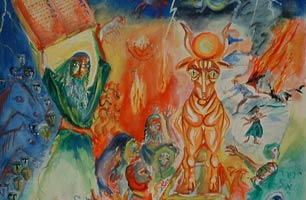
+ Exodus chapter 32 contains the golden calf incident, in which the people, wary of waiting for Moses' return, demand that Aaron construct an idol, which results in the formation of the golden calf. Now, in my mind the story always results in an instance of idolatry, in that the people wanted a physical form of G-d in their midst and thus create the calf to serve as such. However! For the first time, while reading this portion and the commentary together, had I really seen perhaps what was going on. The Israelites were used to having Moses in their midst, and as such, G-d was ever-present -- they viewed Moses as embodied by G-d. Thus, with Moses gone, they needed another physical way to view G-d, something in which G-d could embody. As Hersch says, the people did not understand that G-d had taken the initiative to reach down, believing instead that Moses had power to summon G-d. When I read this and it finally clicked that they were not fashioning G-d, but were fashioning a replacement for Moses (the vehicle of sorts), I immediately thought about the place of Jesus. Perhaps, just perhaps there were those who could no longer view the synagogue as a viable conduit for G-d, and thus sought a Moses-like figure who would embody that presence? I mean, I'm not calling Christianity out, here, but it seems like the classic case of the confused mass not recognizing that G-d would not identify himself through man, necessarily. I think it's a fascinating though, but one that directly connects the two situations -- golden cafe to Jesus.

Feb 14, 2008

T'zavveh: Putting your whole head into it.

Today, my friends, is just another day.

I sat down with the parashah last night. I'll admit that last week's portion (t'rumah) and this week's portion, T'zavveh (תצווה), are -- in my opinion -- more begrudging to read than all the so and so begot so and so sections. In those portions, you at least get all these beautiful explanations behind the beautiful Biblical names, right? But in t'rumah, it was the cubits for building the Tabernacle. It can get a little difficult to read since it's basically a blueprint. As for this week's portion, it was basically entirely about the kohenim (the priests) and their priestly garb. The portion details what stones and fabrics and colors and such that the garb should comprise, as well as the ordination rites for the priests. I'll admit, I read through it pretty quickly, but picked up at least on a couple of things that are worth mentioning. First, a simple quote from the Etz Chayim commentary: "Religion, like so much of life, oscillates between the poles of individual and collective activity" (p.507).

+ When G-d instructs that Aaron shall carry upon his garment the names of the sons of Israel as a "remembrance before the Lord at all times," the Torah commentary suggests that "Remembering is the source of redemption, while forgetting leads to exile." Of course, this thought comes from the Baal Shem Tov and is quite poignant. The thing is, Judaism is so very much about remembrance and the collective memory of the Jewish people. But by remembering, we learn and grow. On the same vein, we are all very familiar with Mordecai Kaplan's oft-mentioned declaration: "The past has a vote, not a veto." I think the Baal Shem Tov and Kaplan both had a firm grip on the importance of remembering and the weight memory has on the collective Jewish identity as it grows and changes.

+ The big thing that caught my eye, though, seems like sort of a stretch. While reading the portion and the commentary, I'm not sure exactly how the editors of Etz Chayim got from point A to point B in their comments on Exodus 29:45, but I'll give them the benefit of the doubt. The excerpt reads: "I will abide among the Israelites, and I will be their G-d." The comments on this seemingly benign and oft-repeated phrase throughout the Torah, leads to some interesting comments. Firstly, this expresses that the people's holy acts alone did not engage G-d's presence among them, but rather it was by the grace of G-d that G-d chose to be present among the people. And here is where they lost me, but my d'var Torah comes from this next thought.

The Talmud asks, "If a priest's body is inside the Tent but his head remains outside, is he considered having entered the Tent and may he perform the service?" The answer (which seems obvious to me) is no (BT Zev. 26a). Now, this was likely a very literal question, for the sake of logistics, but it also incites an interesting question that is less literal. I'll word this question in my own way: If a Jew is in prayer but his head (thoughts) remain elsewhere, is he considered having entered the presence of G-d and may he be counted as present in prayer? The answer, is no.

As I read this and formulated the question, I thought of the Kosher Academic, who I had spoken to earlier yesterday over some delicious swarma from the Kosher cafe on campus. We were talking about going to shul and she was explaining that because her children are of a rambunctious age, she doesn't attend shul often because she worries about them running about and even if they're completely calm, she is constantly with her children on her mind. Interestingly after that discussion I was looking up the eruv locations here in Chicago and came across a little ditty about the importance of childrens' behavior in shul and how sometimes it is perhaps better to not bring them than to come and be disruptive to themselves and those in prayer. Those who keep up the Chicago Eruv web site write:
Despite the cherished place children enjoy in Jewish communal worship, there is no license to restructure our synagogues as indoor playgrounds for the young. On the contrary, the Mogen Avrohom in his commentary on the Shulchan Aruch (ibid) mentions: "And one must train them (the young) that they stand (in Shul) with awe and respect. And as for those that run back and forth in the synagogue in levity, it is better not to bring them."
So it coming back to the idea of one's thoughts and prayer and being at shul. I know I've written about it in the past, but this also comes back to the idea of the mechitzah, which the Kosher Academic and I also talked about a little. The thing is, the mechitzah makes complete sense to me. I mean, it isn't going to completely keep one's thoughts from running amok, but it's one way to attempt to quell the busy thoughts we have as we are trying to come into a place of prayer mentally. I know that when I was attending the Reform shul I found it nearly impossible to focus on anything because I was so distracted by the fact that everyone seemed completely unengaged and unhinged from the services. I felt as though I was alone in a crowd of completely indifferent people there for the social hour both before and after services. It frustrated me and clouded my thoughts. I'll also admit to scoping out the young, attractive Jewish gentleman at services. The article that sort of gave me new insight on the mechitzah is here.

Anyhow, the point is -- prayer requires focus, it requires having your whole head into it, to truly experience G-d's presence. The thing is, how often are we truly clear of mind and completely focused on the task at hand? My ex always joked that I have ADHD, simply because my focus is never on one thing for more than a few seconds. When we go out to eat, I have to face a wall, or else I'm constantly looking around, making observational comments, my eyes flicker from thing to thing. This came in handy in my former job, because so much was going on at once. I find it more difficult now, because I don't have as much to do and when I start something, I start something else, and forget what I was doing until minutes, sometimes hours later. It's frustrating, and even plays into my myriad sleep problems (the mind that will neither shut off nor focus). So when it comes to prayer, I truly have to strive for a clear mind as much as possible. It doesn't come as easily as it once did, it seems, but I know that being fully engaged is of the utmost importance -- so we forge forth, clear our minds, and hope for the best.

So friends, I leave you with that. May you have a beautiful Shabbat tomorrow, or a wonderful weekend, or a restful Thursday and rest of the weekend. In whatever you do, be well.

Also: Check out the Idan Raichel Project! Seriously ... some beautiful/amazing music there.

Dec 16, 2007

I'll admit I'm a little late going here ...

The Torah portion for last week (that is, Dec. 9-15), Vayiggash, had a few interesting tidbits that are worth discussing. I'll make this quick, since I'm already late on the punch anyhow!

+ There's some interesting questions about the situation of Joseph being sold into slavery by his brothers, rising to great power, then saving his family from imminent doom. Firstly, it brings into the question the old "everything happens for a reason" sentiment. It makes us wonder whether G-d truly does have the plan and knows what will happen, or if free will truly does dictate our decisions despite G-d's hand in our lives. Likewise, we have to wonder how, if G-d did "use the sale of Joseph to further the divine plan," (Abravanel) G-d could then hold the brothers accountable for their action. Etz Chayim's commentary says that "G-d could not prevent the brothers from choosing to do something cruel," yet somehow G-d knew that this would further the plan for Joseph and the children of Israel. So how can we -- as mere humans -- really understand what seems to be such an unfair situation for the brothers? We can't. The text reconciles itself by saying later in the text, after Joseph has revealed himself, that his brothers "sent him" to Egypt (Gen. 45:8), not that they "sold" him, thus replacing the evil purpose with its beneficial result. It's truly perplexing, then, to consider how such events could unravel, in what we like to think is a just and logical existence. But this is one of the key instances of the question -- does everything happen for a reason?

+ Interestingly, Israel is the only one of the patriarchs who is spoken to at night (by G-d, that is). I'm not really sure why this is, but I think it probably has some important implications. Note to self: explore this!

+ Interestingly, I think Joseph might be the first assimilationist. The biggest complaint about the Jewish diaspora is that it has completely assimilated to wherever the Jewish people have ended up. Getting rid of the shtetl mentality was key to past generations. As such, many view the Diaspora as being completely devoid of the culture and beauty that it maybe once had. Well, in this Torah portion, there's an interesting exchange that makes us wonder whether Joseph was perhaps a precursor to the Jews of Hellinization and eventually to the Jewish experience in America. Joseph tells his brothers and father to tell the pharaoh that they are breeders, not shepherds, as shepherds are reviled. But the brothers tell him that they are, in fact, shepherds. Why do they do this? Joseph was very concerned about what the Egyptians thought, yet his family -- a simple people proud of their upbringing and profession -- were entirely satisfied with who they were. Joseph had settled into Egyptian life entirely, perhaps even finding himself comfortable with all but ridding himself of his Jewish background and upbringing.

+ Finally, I want to mention a concept in the Torah called mip'nei darkhei shalom, which means "for the sake of ways of peace." That is, it says that one can adjust Jewish law and custom for the sake of peace. I imagine that this was used during the many tragedies that befell the Jewish people throughout history, including during the Spanish Inquisition or perhaps during the Nazi regime. In times where Jews had to practice secretively or quietly, I imagine that certain customs and ways of living had to be adjusted for the sake of survival, and in turn, peace. The important thing about this, though, is that it is not abused or misunderstood. One could say that it's the ultimate Loop Hole in Torah.

Nov 23, 2007

Parsha Time!

I wanted more than anything to create a video blog of me discussing some of my famous comments on the week's Torah portion ... but it just wasn't working out. I wasn't happy with any of my several takes, so I just quit! Eek. I'm thinking that perhaps I should create some type of outline or script, though I'll admit I hate watching video blogs that are completely scripted and you can tell the person is reading off their computer screen! I want lively, personal touches to my commentary and blogging. So for now, we'll stick to the text commentary.

This week's Torah portion is Va'yishlach ("and he sent"), which is Genesis 32:4-36:43. The portion comprises Jacob arriving at Laban's, subsequently marrying Rachel and Leah, growing Laban's flock, then returning to his ancestral homeland, fearing the re-meeting with his brother Esau, struggling with ish ("a man"), wrenching his hip, meeting Esau with open arms, and going about his business. There are a couple of really striking things about this portion, and to get to the most significant one (in my present view), we have to go to last week's portion, Va'yetzei.

+ In Va'yetzei, last week's portion, Jacob makes a vow, but in the context of most of the patriarchs, it's a little peculiar and thus significant. In Gen. 28:20, Jacob makes a vow on his journey to Laban's saying, "If God remains with me .... the Lord shall be my G-d." There is a lot of conditionals in that vow, including making sure Jacob is fed, clothed and kept safe. The peculiarity about this is that Jacob's statement is conditional! In a way, he's bargaining ... saying if you scratch my back, I'll scratch yours, and have you as my G-d, too! When we jump forward to this week's portion, 20 years later and with Jacob's success as a father and husband, we have Jacob making another vow -- but a very different one. In this vow (Gen. 32:10), Jacob says "I am unworthy of all the kindness that You have so steadfastly shown Your servant ... Deliver me, I pray, from the hand of my brother, from the hand of Esau." Jacob's attitude and tone have changed completely. He no longer is bargaining with G-d, he's saying, I have nothing to offer, but please in your wisdom and power, protect me.

The interesting thing about these two vows is the immense amount of commentary on them. There's midrash, and everyone from the Ramban to Rashi has expressed discussion about Jacob's intents. To the Ramban, the key word is the "if" in the first vow. In the Hebrew text, the word is aleph-mem, im. I looked up the word in my trusty Hebrew dictionary and yes, "if" is im. But to Ramban, he translates im as "when." The reason Ramban translates this as such, is because he is trying to make the sentence not a conditional, but as part of the promise. The midrash takes the text from another angle and says that the final portion of the vow "the Lord shall be my G-d" is merely part of the prayer, as much as "Baruch atah Adonai ..." is a part of so many prayers. On another token, the Tosafos believed that although G-d frowns on making vows because we know not where our paths may take us and it is impossible to keep most vows as such, that in times of fear or crisis or uncertainty, such vows are permitted.

I can't help but think that the Ramban is trying to be too easy on Jacob. I don't think that any type of excuse needs to be made for Jacob's conditional vow in Va'yetzei. My own take on Jacob's vow is that ... he's normal. How many times have you sat down in a tough situation and made a vow to G-d that if he helps you or makes you feel better or makes a sick relative well? When I was a kid, I was doing this all the time. "G-d, if you make my (insert relative here) well again I promise I'll pray every night" or "G-d, if you make mom and dad get me what I want for my birthday, I'll read the bible from cover to cover!"

Conditionals with G-d are how we function. It's hard for us as humans to really conceive of something as *not* being conditional. When you buy something, you exchange money. When you get a new job, you make sacrifices elsewhere in your life to make it happen. There are conditions to all things, and it's hard for us to conceive of something just happening without our doing something in return or there being some transfer of "if ... then." We make conditional, bargaining statements because it's how we function, and it's really all we know. We can't all be Moses, can we?

+ In Gen. 32:25, prior to his meeting with Esau, who he fears might kill him, Jacob struggles with ish (a man), coming out with a wrenched hip after a night of wrestling. The big question, though, is who is Jacob wrestling with? Some say it's Esau's guardian angel, trying to weaken Jacob before his meeting with Esau. Some say that it was a messenger from Heaven. But in my opinion, the best take on it is that Jacob was wrestling with himself. Once again, it's a very human thing. We often struggle within ourselves over just about everything, and it is often said that we, ourselves, are our biggest enemy and hurdle. It's amazing what one's mind can do in the way of convincing or discouraging an action.

When I was in high school, I could only officially make the freshman volleyball team if I ran the mile in 10 minutes. Now, mind you, I wasn't a runner and had never been physically active, but making the volleyball team was huge to me. I had all the skills, but not necessarily the ability to run a mile quickly. At about 9 minutes 30 seconds, I was the only girl left on the track. Everyone was yelling and cheering me on and in my mind I was struggling. I was wrestling with myself, the angel and devil if you will, one saying "you can do it!" and the other saying "just give up, you've never done it before, and you won't now." Then the varsity volleyball coach ran up next to me, with a half-lap left and explained to me very carefully that the only thing holding me back was myself. That's what I needed to hear, and I pulled it off in something like 9 minutes and 50 seconds. I can sympathize with Jacob -- can't we all?

+ Finally, I just want to reiterate something that I'm sure I mentioned in last year's post on this portion. It relates to the last discussion about the wrestling and the hip wrenching. This verse is where we get one of the main kashrut laws. Because of the hip situation, Sephardic Jews require that the sciatic nerve be extracted from the animal and Ashkenazic Jews require that the entire hind quarter be considered unfit for consumption! So if you ever wondered why that rule exists or where it came from ... now you do!

There are actually a lot of other interesting aspects of this portion (like why the "man" -- if it is an angel -- remains nameless, and all angels are nameless until the Babylonian exile; or the fact that Esau embraces Jacob, despite what would be expected, though in future generations Esau's descendants will help destroy the First Temple), but I'll leave it here for now. I wish I could have said this all in video form ... but I've got some work to do! Eeek.

Shabbat shalom, and may this Thanksgiving weekend be a blessing unto you all!

Oct 30, 2007

Hayyai Sarah: A deeper look!

First off, mad props to Blogger for finally setting up the blog-o-sphere so that comments can be tracked (I was really bad about going back to places I'd left comments to see if there was a response, not to mention that CoComment did weird things to my browser, so I got rid of it).

Secondly, I seem to have this weird problem. There's another Jewish woman in my office. I'm nearly positive she's Orthodox, though I'm pretty sure she's Modern Orthodox. The problem is that we never talk. I mean, we should have things to talk about, right? I don't mind saying "Yo! I'm Jewish!" to other people, but for some reason, things are not as easy with this gal. We were both in the copy room today for like 10 minutes together and nothing beyond "How are you?" "Fine, and you?" "Fine, thanks" was said. How awkward ... anyone have any icebreakers for Jews?

Thirdly, and most importantly, I find myself reading Torah very differently than I did even a year ago. This week's Torah portion is Hayyai Sarah, which is one I recognized immediately. It's the portion where Sarah dies, she's buried, and Abraham sends his servant out to find Isaac a wife and he comes back with Rebekah and then Abraham dies and is buried with Sarah. It's pretty basic and there isn't a whole lot of depth to the portion -- but I gather that this is because several things I might question (the oath by genitalia, love after marriage, the discrepancy in the storytelling in each version) I questioned last year in my blog and thus answered. I also find that I question things differently; I ask questions in the style of the sages in Talmud! I think this is a reflection of reading Rashi's Daughters, as the amount of commentary and discussion that takes place is too much to count! I say this because the questions I derived from my Torah study this evening were not answered in my chumash, like many of the basic question's answers are. Thus, these provide more room for exploration, which makes me wish I were a Talmud chacham. I find myself exceedingly jealous of the children raised Jewish with Talmud learning and especially Rashi's daughters, who were so learned ... jealousy!

My queries on Hayyai Sarah:
  • At the beginning of the portion, how did Abraham choose the land to buy in which to bury Sarah on? He very quickly and explicitly chose the cave on the land of Ephron, but what was the significance of the spot? We know that the purpose of buying the land was to establish residency so he would no longer be a stranger in the land, and also because he knew that the land would someday be theirs, as given by G-d ... so establishing a sense of ownership was important. But why the cave on the land of Ephron? What was special about this space?
  • In Gen. 23:10, did Abraham inadvertently violate the law that says one may not approach the land owner directly, but must first deal with the "people of the land"? I ask this because when Sarah dies and Abraham is talking to the Hittites about needing to procure land, he says he wants the cave on the land of Ephron. Without knowing it, Ephron is in the crowd and responds to Abraham. However, this violates the law I guess. But what are the repercussions? If any? (There were none in the Torah, of course, but I'm speaking about the "what if" here.)
  • How much land was there with the cave in the deal Ephron made? It was a 400-shekel deal, but there was no speculation in my chumash about the size of the land. It also didn't discuss what the land was used for. Was it worked by the Hittites? Was it barren? If there's all this land with a cave amid the community, wouldn't it be used for something?
  • In Gen. 24:16, and throughout the story of the servant and Rebekah, there is a discrepancy of the well versus the spring. I imagine the two words could be interchangeable, as a spring is a source of water from the ground and a well is a hole dug to create a water source. But in this verse it says that Rebekah "came up" from the spring ... would one have to "come up" from a well? Maybe I'm not familiar with biblical well-going, but that seems awkward. I suppose it could be chocked up to different authors or translations?
So that's my Torah babble for this week. Stay tuned ...

Oct 27, 2007

A productive, thoughtful Shabbat!

Although Shabbat quickly draws to a close ... I wanted to toss out something I just read in "To Life!: Prayers and Blessings for the Jewish Home" by Rabbi Michael Shire, which I just bought off the sale table at the local Borders.
Shabbat ... is the mainstay of Jewish family life, offering a weekly respite from work, and a time to be rather than to have. Ahad Ha'am, the famous nineteenth-century Jewish esasyist, poignantly remarked: 'More than Israel has kept the Shabbat, the Shabbat has kept Israel.'
I think what I like most about this is the "a time to be rather than to have." This is the essence of Shabbat, and it would appear that this Shabbat has been most insightful for me. Not only did I fill up three pages of my notebook on notes/thoughts/commentary on this week's Torah portion (Va Yera), but I also did some reading in Isaac ben Abraham of Troki's "The Strengthening of Faith" (Chizzuk Emunah), which basically defends Judaism and sort of goes point by point (and citation by citation) as to why the Christian disputation of Judaism is wrong, wrong, wrong! It was a productive afternoon, by golly. I'll likely post my Shabbat comments tomorrow (a little late, but better later than never!), as I"ll be heading out for the night shortly.

On another note: Going to Borders is so dangerous for me ... I went with the express purpose of buying a workout DVD (which I bought) but then also picked up Ani Difranco's "Canon" (eeep!), not to mention "To Life!" I also collected two or three other books on a list to add to my Amazon Wish List, including:
Feel free to get me anything you deem necessary ;)

Sep 25, 2007

The final Parshah.

"And there was no other prophet who arose in Israel like Moses, whom the Lord knew face to face ..." (Deut. 34:10)

This found its way into Maimonides Thirteen principles, chiefly within the following:
7. I believe with perfect faith that the prophecy of Moses is absolutely true. He was the chief of all prophets, both before and after Him.
8. I believe with perfect faith that the entire Torah that we now have is that which was given to Moses.
Key in the initial citation to note is "in Israel," which makes one wonder if this is a foretelling that perhaps such prophets will arise in other nations, among other people. A midrash touches on this in the following:
Never again did there arise in Israel a prophet like Moses, in Israel there did not arise, but among the nations there arose, so that the nations should not have the excuse to say that if only we had a prophet like Moses we would have worshipped the Holy One. And which prophet did they have like Moses? Balaam the son of Beor” (Numbers Rabba 14:19).
Is it suggesting that other prophets of the caliber (in the eyes of worshippers) arose out of envy for Moses? Did envy or visions of grandeur birth the great prophets (visionaries) that birthed Christianity or Islam or Mormonism?

Or, perhaps, the key idea here is that what Moses (via G-d) gave to Israel was greater and unlike anything that would ever arise. Torah! As the greatest revelation from a prophet such as Moses, it never again will be repeated or regiven or redacted. It is THE ultimate final say.

Either way, this brief sentence at the very end of our Torah, before we begin again, inspired Maimonides in his Thirteen Principles (of course, which I'll discuss at some other time when I have more time to explicate on the many points, which I might not exactly agree or understand or GET), which says something. It is not enough to say that Moses was a prophet -- no, he was THE prophet.

This take on the situation seems pretty spot-on:
In the Yigdal prayer in the morning service, we read, "No one from Israel arose like Moses. . ." Could there have been another Moses? Theoretically, yes. But did anyone reach his lofty heights? Only Moses earned the right to ascend Mt. Sinai and accept the Torah directly from Hashem. Moses was just a normal human being who overcame his evil inclination and reached his vast potential. He was a man of physical defects who was slow in speech and spoke with a lisp. Nobody can say that it was his great oratorical skills that mesmerized an entire nation into following him. Moses was a far cry from one who could preach matters in his own words or give expression to divine truths. He was a scribe who could sit before Hashem on Mt. Sinai and take perfect dictation. Moses was the secretary who mirrored the ideals of his divine boss. Interestingly, Moses' Hebrew name Moshe, spelled mem, shin, hay, mirrors that of Hashem, spelled hay, shin, mem. Moshe spelled backwards reads Hashem.
Even the dissection of Moshe and Hashem is pretty compelling (if you're into etymology and a little superstitious like me).

Of this week's entire portion, this is the bit that moved me most. What a man, what an amazing man and what a gift -- or burden. And at the mouth of G-d, Moses passed. A thoughtful kiss goodbye.

Sep 5, 2007

TORAH! And Work.

First, a quick read on this week's Torah, which allows us some of Moses's last days. Then, a bit about work and some thoughts I'm having.

+ The double portion this week -- Nitzavim-Vayelech -- expresses some of the most basic and fundamental tenets of Judaism. Its opening beckons all men, women, children and converts within the camp. This is the all-encompassing aspect of Judaism!

+ Deut. 29:14 -- "But not only with you am I making this covenant and this oath, but with ... those who are not here with us, this day." My first inclination was that this is speaking of future generations. I checked out Rashi's commentary and BAM! Same thing. This may seem like a "duh" thing, but that could be interpreted as those not present (idolators, people elsewhere, etc.), or future generations, or past generations.

+ Deut. 29:28 -- "The hidden things belong to the Lord, our G-d, but the revealed things apply to us and to our children forever: that we must fulfill all the words of this Torah." I had to read this sentence several times and do some web searching before I got the gist of it. Then I found this great explication over on the Edinburg (yes that Edingburg)Hebrew Congregation website. In sum: "Our verse, therefore, comes to tell us that we are only accountable for the ‘revealed things’: the way society acts and behaves; not the ‘hidden things’ of everyone’s private behaviour." It definitely emphasizes the importance of community!

+ Deut. 30:6 -- "And the Lord, your G-d, will circumcise your heart ..." Okay. On the surface, yes, this is the spiritual representation of the physical circumcision as ordered by G-d. During the wanderings, circumcision ceased temporarily, but now, as they enter the land, the Israelites are called to circumcise their hearts (this also appears in Deut. 10:12-16). I was sort of shocked that when I did searching on the web for this portion, most of the sites that came up were Christian sites, and the second top site was a Jews for Jesus article. They all say similar things ... and they're all pretty ... Jesus-y.

-----RANDOM NOTE: One of the Temple Sholom staff members, and my personal favorite -- Josie A.G. Shapiro -- is on Dinner: Impossible! WOW!!!! -----

+ Deut. 31:17-18 -- These must be what prompted so many to assume that after just about every major catastrophe (inquisition, pogroms, Holocaust) that surely G-d had turned away his face and that surely it was "because of all the evil they have committed." So many who called for Jews to convert after such travesties probably eyed these events and these verses. It also calls into attention the "why do bad things happen to good people" adage. It's why -- so often -- when someone dies or a tragedy happens, pundits and zealots automatically scream "YOU WERE BAD! YOU ARE BEING PUNISHED!" But there has to be more to this than what comes off the surface. G-d isn't just a punishing god, there's compassion in there. In all my bad moments, never once have I said "I have earned this, G-d has turned his face from me. I have been abandoned."

--------------------------------------------------------------------------------------

Now for job stuff. Every morning on the #66 bus down Chicago Avenue, I ride past the nearly open Dominick's grocery store. It's going up right next to a McDonalds -- one of the few chain restaurants on my end of Chicago Avenue. The moment that the "Now Hiring" sign showed up outside the store a few weeks ago, I turned to Ian on the ride and said "Hah, maybe I should apply there!"

Now, I'm not presently searching for a new job. In the future, yes, I'll be looking for a new job that's a little more up my alley. But here's the thing.

I want a mindless job. I want a mindless job so that I can focus on the things that matter: reading, Torah, Hebrew, my studies.

Every morning I ride by that store and think that if only I didn't have bills and groceries to buy and things and stuff. I could get by on minimum wage with the minimum things, working a mindless job where I can disconnect myself when I leave. Where I can hop on the bus and be there two seconds later. Where I can spend my spare time thinking about literature and Rashi and things that mean something to me, instead of all the things that don't (ahem, those things at my present gig).

I don't hate my job. It's just completely not stimulating. It has nothing to do with anything that has to do with me. And if I'm going to work a job like that, I want it to at least be less all-consuming and something that doesn't cut into my after hours.

So maybe I will look into working some slum job like a grocery store or retail. It would kill my father and it would make me look like a complete shmuck. I went from a job hundreds and thousands would kill for (Washington Post) to another job dozens if not hundreds would kill for (working for a Nobel prize winning economist). So if I called it a day here and went downhill in order to go uphill to what I want to do ... wouldn't it be worth it?

So maybe. Just maybe I'll be bagging your groceries someday. I'm not so prideful that I wouldn't do that. I'm the girl who worked at McDonalds and Wal-Mart growing up. The end goal is being happy and doing something that I'm passionate about, so in any case, the means are not necessarily the most important thing on my mind.

Jul 11, 2007

Vayedaber Adonay el-Moshe lemor...

I'm not going to lie. My love affair with this website is deep, passionate and full of all sorts of educational enlightenment. It not only offers Torah, the transliteration and the translation, but also sound clips of the portion! Did I mention that the Hebrew appears both WITH and WITHOUT vowels? Talk about brilliant. There's a wealth of knowledge here beyond this, though. Within the translation of the text, there are words that are linked to mini-commentary/details at the bottom of the page. Just click and bam, you get some nice tidbit. I suppose I should also mention that the site *is* a bar/bat mitzvah tutor, which is probably why it's full of all sorts of genealogical, reference and help material! The genealogical portion of the site is pretty snazzy ... you can find out the immediate "relatives" of any of the names in Torah! How cool!?!?!?!?!? Now the commentary isn't as detailed or extensive as my Etz Chayim, but it's a pretty stellar way to get the parshah done.

---------------------------------------------------------------------------------------

This week is a combo of Mattot and Ma'sai, which finish up Numbers. The first portion is dedicated to the "holy war" of sorts on the Midianites in order to "avenge" G-d after the events at Baal-peor. The second portion is mostly a recap of the years wandering; that is, where we camped out and what happened.

Though there wasn't a lot in the portions that struck me as intellectually divisive, there was one bit that struck me as relevant. In Ma'sai, there's a portion (Num. 33:53) that reads Vehorashtem et-ha'arets vishavtem-bah ki lachem natati et-ha'arets lareshet otah. In translation this basically is saying that we must clear out the land that G-d has given to us, because, well, G-d gave it to us. I think this is interesting, and the comment points out that this is often cited as evidence that the whole of the land is ours, and probably is where radical Jews get their view for much of the tussle over who Israel truly belongs to, and why some will stop at *nothing* to return the land fully and completely to the tribe.

The other thing I found interesting actually has me backtracking to Mattot. While in the heat of battle, the heads return to Moses and he's all up in arms because the fighters neglected to kill all of the women of sexual maturity when it was they who had seduced the Israelites (Num. 31:14-17). As such, Moses has them return to kill all of them women who were sexually mature (i.e. not virgins). What I'm wondering is how the troops knew who was sexually mature and who wasn't ... what type of test do you formulate to acquire such knowledge of a woman's sexual experiences? I imagine this is something in the Midrash, and perhaps I'll get to looking someday. It seems curious, though, that such large numbers of people would have to be examined in some way to deduce sexual maturity ...

And finally, as I pondered perhaps the difficulty Moses might have had in the demolition of the Midianites because his wife, Tziporah was a Midianite, and after doing some looking and examining, I'm drawn curiously to the long-standing discussion about Tziporah and whether she was a Midianite or a Cushite. I guess that makes me wonder whether Moses would have been upset about it at all, seeing as how it's undecided whether there were two different women, who was a concubine, what Tzippy was, etc. The reason this struck me is because the commentary in Etz Chayim Numbers 31 cites that Moses might not have participated in the physical killing because of his sympathy and concern due to Tzippy's being a Midianite and all. Puzzling!

Jun 27, 2007

The Wandering Blog

I don't have much (if anything) to say expressly about Balak, this week's Torah portion. The only sort of thought-invoking bit of commentary in Etz Chayim is in regards to Balak's urging for the curse on the Israelites and Balaams persistent relaying of G-d's message that you cannot curse those who are blessed.

The text cites the Baal Shem Tov, who said "A Jew is never alone. G-d is always with every Jew." Then there is Abraham Joshua Heschel (not cited here, but all the same), who said "The Jew is never alone in the face of G-d; the Torah is always with him." Is G-d with us? Torah with us? Neither? Either? Both? Are they one in the same?

I was watching this episode of "Whose Wedding Is It Anyway?" on Style last night, and I was taken by one of the stories. It was a couple who had hastened their wedding vows after they'd started dating. Why? Well, she was diagnosed with an incredibly rare form of leukemia (.5-two people diagnosed each year worldwide) and given three-five years to live. She surpassed the time frame and six years after the diagnosis met the man. His story was that he'd been in a horrible car accident on an exit ramp on the freeway and had walked away. Less than a week later, because of a concussion and emotional trauma from the other accident, he rammed his car into the back of a city truck, completely decimating his vehicle and causing his near death. Then they met, realizing that they both were sort of knocking on heaven's door, fell in love, and got engaged. I don't consider it a miracle or necessarily a gift from G-d that either of them are bright, shining people who are giving back with a cancer scholarship and countless philanthropic activities -- they are the epitome of the perfect romance. However, I have to think that perhaps the everyday presence of G-d maintains some balance, some equilibrium. Then again, I don't even know if these two people were religious -- let alone Jewish (not that that matters).

If you Google "A Jew is never alone" ... you receive (at present) 76 entries (though only about 20 *really* show up). Many are variations on the Baal Shem Tov's famous words. Then there's random expressions of the Jew and his loneliness: "The Yarmulke is a constant reminder that a Jew is never alone. He walks with G-d. It is a feeling of assurance and comfort" (Jlaw.com).

It would seem that the Jew is never alone -- be it G-d or the yarmulke as a reminder of G-d or the mitzvot and laws of G-d in Torah. I imagine it is whether we accept or deny this as such. Does the denial of the constant presence make those moments in which we pray hard and fast for the protection of a sick relative or lover that much more effective and strong -- in OUR eyes? I often look at the religious Jew, he who is constantly swimming in Torah and wonder if -- when there are moments of desperation -- he feels as effective and firm and hopeful in his prayers as he who perhaps only calls on G-d in moments of crises. The constant presence may dull the effectiveness (in our minds, that is), nu? On the other hand, acknowledging the constant presence might allow us to take G-d for granted, to not appreciate the peace of mind.

Okay, so I lied. I had plenty to say about this tiny little quip of the Baal Shem Tov. I just didn't anticipate it.

I have quite a bit to say about the book I'm reading, Women and Jewish Law by Rachel Biale, but I'll save that for a little later this week or early next week. I have to say, though, that it's one of the most well-written Talmud-heavy texts I've read in a long time. Often I find such books hard to keep down, but Biale is BRILLIANT in her presentation of the texts. That is, she offers the Talmud text, then piece by piece explains in plain text (but not dumbing down) what exactly the sages were saying, then examines the evolution, importance, contradictions, and actual application of the laws. In the long run, I think this might help me if I decide to pursue/examine Rashi's daughters (or the women of Rashi's time/area in general) and the extent of his sentiments/interpretations of certain laws, including womens' study of the major texts.

Until then, shalom my friends. Stay cool in summer's heated breeze!

Jun 21, 2007

Welcome back, Chavi.

Ian has started school, and that gives me two nights out of the week to devote to Torah. Because of my sad dedication to Fox's "Hell's Kitchen," that knocks Monday night out. So Wednesday is now Torah Thyme (his slogan, not mine!). In the past three months I've neglected to read 3 or 4 of the parshah, which has given me this gigantic guilt complex. I loathe going to shul on Friday and not being previously knowledgeable on the topic at hand. I prefer to be prepared!

This week's Torah portion is Chukkat (חקת), and includes the dreaded moment when G-d tells Moses and Aaron that they won't enter the land, following the water/rock fiasco. I found a couple of interesting points and commentaries in Etz Chayim this week, including what could be construed as an allusion or validation of Christ in Christianity. But first, I have to mention an article I read in "Reform Judaism," the URJ's publication, regarding kashrut and an interesting take on the text.

In the summer issue, in "The Civilized Diet" -- a conversation with Rabbi Simeon Maslin -- the origins of kashrut are discussed and the text is addressed in a most interesting way. According to Rabbi Maslin, the instances of the law to "not boil a kid in its mother's milk" appear in relation to pagan sacrificial rituals, suggesting that such acts were forbidden to Israel so as to avoid practicing pagan rituals. He points out that the three times it appears in Torah, not once does it appear within the exhaustive list of dietary laws in Leviticus 11. The article is mostly dedicated to the idea of eco-Kosher, or "keeping with the spirit and intent of Torah." Eating, as it were, is an act that should receive much more attention than it does (i.e. appreciate and understand what you are eating prior to consuming it, appreciate the animal that died and where it derived). But his point about the appearance of this key component of kashrut is particularly interesting. He says he appreciates that many avoid mixing milk and meat as a respect for thousands of years of history or the idea of avoiding the food of persecution (pork, for example, because it was an identifier of Jews during the Inquisition), but for him the milk/meat "law has nothing to do with the prohibition against eating." There are a few thoughts here. In fact, Maimonides also suggested that in biblical times there were pagan cult rituals which involved the cooking of a kid in its mother's milk (Guide of the Perplexed, III-48).

On to Chukkat! I have just a few things I'd like to mention and a few questions I'd like to pose.

+ There are plenty, PLENTY of citations of ways to become unclean in the Torah. One, cited in this parshah, is dealing with corpses. Torah cites that one is unclean for seven days upon touch a corpse, but what I wonder is whether ... and perhaps this is a stupid question ... the number of days one remains unclean varies by the number of corpses one touches ...?

+ In Num 20:1-13 is the explanation of using the ashes of a brown (red) cow to atone for sins. The comments listed in Etz Chayim says something interesting: "Just as the ashes of the brown cow atone for sin, the death of a righteous person does the same (BT MK 28a)." The first thing I thought of when I read that was the concept of Christ and the basis for Christianity. I think it's interesting that the Talmud says such a thing about the death of a righteous person being akin to atoning for sin ... am I crazy here? Or could this be a valid citation for a Christian theologian to say "See! See! The Talmud says so!!! Jews for Jesus!"

+ I had another query, but then I Googled it and "Judaism 101" (JewFaq.org) had the answer! I think it's quite interesting, and I hadn't a clue. Num. 20:29 has a notation that although the mourning period of losing a parent is 12 months, Kaddish is only recited for 11 months. I thought this was a *little* strange, but alas! Here's the explanation from the Web site:
According to Jewish tradition, the soul must spend some time purifying itself before it can enter the World to Come. The maximum time required for purification is 12 months, for the most evil person. To recite Kaddish for 12 months would imply that the parent was the type who needed 12 months of purification! To avoid this implication, the Sages decreed that a son should recite Kaddish for only eleven months.
Brilliant! Thanks Judaism 101!

+ I have to make a note about this appearance of "Oi!" in this parshah. I don't know if I've missed it before, but this is the first time I've seen it in Torah. In Num. 21:29, there's sort of a "woe unto you" spiel that says: "Woe unto you, O Moab!" and in Hebrew is אוי לך מואב! or "Oi-l'cha Moab!" Beautiful, nu?

And that's it for this week. I'm trying to get better about my studies, so here's to hoping for more regular posting, more Torah thought, and more Judaism, darn't! On that note, Ian and I are officially becoming members of Temple Sholom here in Chicago. It's the first time in my life I've paid "dues" to be a part of a religious organization (in Lincoln my monthly bulletin duties and the fact that I was a poor student got me by for temple dues). In the coming months, hopefully I'll be able to plan on participating in many of the synagogue's committees, activities, and perhaps what I'm most excited about -- Adult Education courses! Hoorah!

Here's to the weekend, and a relaxing Shabbos to my friends and readers!

Apr 15, 2007

A little late on the parashah ... Sh'mini!

Perhaps the most significant aspect of this week's parshah (for me) is the discussion in Etz Chayim regarding kashrut. I'm often asked why I hold on to "archaic" or "outdated" mitzvot like not eating pork or not mixing milk and meat. I have my reasons -- much like everyone else does -- and they vary from person to person. Is it wrong to not just say "Because Torah says so!" ... HELL NO. (My biggest beef with Christianity growing up was that I was discouraged from asking questions. That was also one of my biggest draws to Judaism!)

Before I talk kashrut, I want to mention a few other things in this parshah, which begins with two of Aaron's sons being consumed by flames.

In this portion of the parshah, Aaron raises his hands to G-d and blesses the people before him, which made me wonder if this is where the belief that the 'live long and prosper' hand symbol arose from the priests of Temple Judaism. Leonard Nemoy took the hand symbol (of which I'm sure everyone is familiar) to Star Trek, saying that he remembered making the gesture in shul when he was a lad. I have yet to run across anything in Torah that specifically details the hand signal, but I'm still looking out for it. Curious, nu? Here's a site with some insight: Jewish origins of the Vulcan gesture.

The debate over Nadab's and Abihu's sin (and what it was) is ongoing. Etz Chayim says "Their sin, if any, was a lack of faith, trying to help G-d in a situation in which G-d did not need their help. (Mekh.)" Sages have said the fire was the "fire of ambition" and that the boys were trying to supersede their edlers, while others have said that the brothers were motivated by EXTREME piety. That is, they wanted desperately to be close to G-d and got lost in the effort to attain extreme closeness. Even still, it has been argued that their bodies were not completely consumed and burnt by the fire from G-d, because of phrases later that say the men were carried away by their tunics. Rather, it has been suggested that their souls were completely consumed, resulting in Nadab and Abihu becoming spiritually ruined.

On the same note, within the commentary it says something that I wasn't really aware of, but it regards recent losses (death, of course). Jewish law counsels us AGAINST trying to comfort individuals right after a loss. This goes against nature, considering when someone close to us is hurting we want immediately to help them feel better. But at the same time, there's something strange about doing so ... which makes this little bit of Jewish law pointed.

NOW! For the little morsel I wanted to share. I'm perfectly solid in my reasons for not eating pork, shellfish and beef/dairy combos, among other things. But whenever I can find more satisfaction and law in my decision, I get giddy and it helps the moral effort. Etz Chayim highlights the issue as such: We are commanded not to ingest blood, thus, we should not consume animals and birds of prey that ingest blood, because this puts blood into our food system. Ta da! Brilliant! Additionally, the comments admit that keeping kosher reminds us that there is "a moral difference between eating an apple and a slice of meat." Why? Because one of G-d's creatures had to be slaughtered for the consumption of the meat. Keeping kosher creates a consciousness, which I like.

Okay, that was probably a false buildup, but I thought those two little bits there about kashrut were poignant.

Mar 23, 2007

Va-Yikra!

It's almost Shabbat, and this is the first of many Shabbats that I get to observe and cherish. Amen!

This week begins Leviticus and many of what were deemed laws for the Kohanim (priests). Nearly half of the 613 mitzvot are found in this book! The parshah discusses sacrifices and rituals, including offerings for sins, peace, meal and etc. Again, I'm more or less transcribing notes I took while scanning the Torah at my new coffee digs. (The computer died, else I would have typed it up yesterday.)

+ The comments at the beginning of Leviticus stresses the difference between sacrifice in most Near Eastern myths compared to that of the Jews. Sacrifices were common, of course, but the difference is that in most traditions, sacrifices were made to give strength and power to the beings worshiped by others. For the Israelites, though, sacrifices were meant as devotion. There was no conception that G-d was made more powerful by the sacrifices of the Israelites.

+ People often ask me why I don't eat pork or shellfish. Or why I keep other certain mitzvot that might seem archaic or outdated. Etz Chayim sums it up pretty accurately regarding the rituals we find throughout Leviticus, and why we should consider and keep them even today when the meanings might escape us immediately:
"Rituals, including prescribed prayers, tell us what to do and say at times when we cannot rely on our own powers of inspiration to know what to do or say."
+ A question: Where/When/How/Why did animal sacrifice come to be? I'm curious why animal sacrifice became a logical need or practice for people. How it developed as such a wide-spread ritual. I mean, it seems absolutely obscene to modernity ... so how did it develop in the mind? I'm going to have to research animal sacrifice ... for I am curious!

+ Furthermore on ritual and sacrifice and why it should apply even today, Etz Chayim says: "Each generation must find new ways to make G-d present in new situations that the Torah could not have foreseen." It goes this way with just about anything ... we adapt, we grow.

+ Lev. 1:9 -- There's a curious comment on this line about the odor of the sacrifices being pleasant in G-d's sight. Midrash states that "G-d smells the odor ... of the burning flesh of Jewish martyrs ..." (Gen. R 34:9). The comments point out that this is sadly ironic, considering the events of the Holocaust. Again, something I want to look further into ... to see exactly when the Midrash was written.

+ Among the sacrificial rules ... "kol helev l'adonai" or, "all fat is the lord's." This goes along with the command that we are to not consume blood or fat. I find it curious that blood libel myths were so popular considering this very simple biblical command.

+ Lev. 4:1 -- within the purification offering (hattat):
"The purpose of the hattat ... was to acquaint the donor with one's own more generous side, so that instead of seeing oneself as weak and rebellious, a person could say 'sometimes I am weak and rebellious, but that is not the real me. Often I can be generous and obedient.' It was an opportunity to clear one's conscience, not a penalty for having done wrong."
It's related to Yom Kippur, when we atone for our sins. There's also mention of a brief period of confession, though confession has never been a part of Judaism and rather is the hallmark of Catholicism.

+ In reference to Lev. 4:2, Rambam says "It is in the soul that the impulse to do wrong begins." When I read this I was curious if it was an endorsement of inherent evil by the Rambam. There's the great debate of nature versus nurture and of course it includes the discussion of whether we learn to be evil or if it is within us upon conception. Again ... research!

+ One of the instances for sacrifice was in the instance of committing a mitzvot, but doing it in such a way that it is done wrong. In response, Levi Yitzhak of Berdichev thus said that "sometimes it is possible to perform a mitzvah in such an improper manner that it would have been better not to do it at all." I thought this was amusing ... but of course it's true. If you don't know what you're doing, you best step back and figure it out, lest you miscommit the mitzvah!

Mar 22, 2007

A quick recap of last week's parshah (there were really two of them!):

I didn't get a chance last week to blog on the parshah(s), which was pretty crumby, but things came up and with the GREAT MOVE to Chicago, there was a lot going on. The move ended up going pretty well, despite some initial catastrophes with picking up the car and having to drive through a decent snowstorm. But we made it. On my way to the airport to pick up Ian, I got through last week's parshah pretty quickly. So I'm simply going to transcribe some of my notes that I took, if not for the inquiry of the reader, then for me, myself and I in future adventures in Torah study.

+ Ex. 35:3 -- "you shall kindle no fire." The comments suggest that some sages saw "fire" in both a literal and metaphorical sense, as in one shouldn't harbor anger on the Sabbath. What if that is ALL that phrase meant? And our whole concept of not starting fires and popping on lights is a misinterpretation of a phrase that could be interpreted at face value, but wrong?

+ Ex. 35:31 -- Rashi has an interesting take on skill, ability and knowledge (this, of course, in reference to Bezalel who is tasked with doing this and that and everything else). The comments read:
"Rashi defines 'skill' (hokhmah) as what a person learns from others, 'ability' (t'vunah) as the result of one's own insight and experience and 'knowledge' (da'at) as divine inspiration, ideas that suddenly come to a person from an unknown source."
I suppose I'm fascinatd by this because I'd never thought about the difference in the words, or, rather, the significance of each.

+ "Wisdom of the mind alone, without wisdom of the heart, is worthless." -- Aaaron of Karlin (a Hasidic master, on Ex. 36:1)

+ Ex. 34:2-7: Why is it significant to emphasize the people bringing TOO MUCH? There's several lines ... but why?

+ In the construction of the tabernacle, the word adanim is used multiple times (its meaning is translated as "sockets"). The word derives from a similar source as Adonai. The adanim hold together the upper and lower portions of the ark, just as Adonai holds together the upper (spiritual) and lower (material) worlds together. -- Menahem Naham of Chernobyl

+ What is the significance of blue, purple and crimson? The colors are used in the yarn, but it appears in stained glass and facades of synagogues the world over, not to mention on holy garments and utensils and dishes. I can't seem to find a source who really delves into the meaning of such colors, though. The search continues!

+ Why is there SO MUCH gold that goes into the tabernacle? Why is it that G-d's place need be so extravagant? I'm not one to believe that G-d must be crowned king in the way that human kings are adorned in gold ... it just seems wrong and not representative of the Israelite G-d. Am I nuts to be so irritated at the EXTENSIVE use of gold?

+ What is the significance of the cloud? Why does G-d descend in a cloud?

+ The comments at the end of parshah P'kudei are incredibly profound. I must share the thoughts of the Etz Chayim:
"There are moments (a wedding, the birth of a child, an escape from danger) when G-d erupts into our lives with a special intesnity that transforms us but that is too intense to be lived constantly. Then there are times when G-d is a constant presence in our livies (marriage, parenthood, years of good health) in an equally real but less intense manner. The challenge is to recognize G-d's constant presence in our lives without its becoming so ordinary that we take it for granted."
True it is. How is it that we keep G-d as a constant? How, through the day in and day out, the mundane and ever-changing/never-changing that we maintain a constant hum within ourselves of the divine presence? It is a challenge I'm willing to take on, of course.

---------------------------------------------------------------

Guaranteed, there will be comments on this week's parshah, as we begin ... the book of Leviticus!

Shalom. Be well!

Mar 7, 2007

Ki Tissa, just a few brief comments.

Sometimes when reading Torah and collecting the accompanying midrashim and commentary, I wonder how the great thinkers came up with some of the stuff they've derived from the parshah. An example from this week's portion is from Ex. 31:18, when G-d presents Moses with "two tablets of the Pact, stone tablets inscribed with the finger of G-d." The word for stone tablets, even, or aleph-bet-nun, is translated by one sage as av-ben, meaning "father to son." The translation caters to the idea that the commandments are to be passed from father to son and so on.

Now, call me crazy but I would never have gathered that. Then again, I'm not a life-dedicated Torah scholar (yet). The way the sage goes about coming to this conclusion is that bet can either be a b or a v, depending on whether a dagesh is present. The dagesh, of course, being a little dot that appears in letters like tet or pe or kaph. It alters the meaning of the letter, according to the letters around it, as well as the vowel sounds. The dagesh is a mighty little marker. Thus you can have aleph-bet (dagesh) and bet (no dagesh)-nun, if you were only so creative to notice such intricacies of the word.

Man. I hope I can rock that hard in my pursuits someday.

Likewise, backtracking a bit, this parshah begins with a donation of a half-shekel by every individual older than 20 (a common belief is that religion is not suited for children, only adults can understand the depth and magnitude of religion and Torah). The donation is cited as "each shall pay," which in the Hebrew is v'nat'nu, or vav-nun-taph-nun-vav. Holy Moses! A palindrome! And a mighty important one (yet something else I probably wouldn't have gathered all on my own, amazing sages). Some have said that this suggests that charity is a two-way street. The Vilna Gaon says that this reminds us "that one who gives today may have to receive tomorrow." How true!

-------------------------------------------------------

I have to admit that right now, my level of distraction is incredibly high. There's too much and too little going on at once, and I'm trying to find some balance. I will work the next seven days straight, the only brief excitement being visiting with and getting a drink with a friend visiting from Nebraska and another who recently moved here.

But between now and then and then and when Ian arrives and when I move to Chicago (March 16), is 9 days of tumult. I find it hard to focus at work, hard to focus at home, hard to focus at my coffee shop. I watch people. Gazing, skimming the thought of staring. It's a cascade, or at least it feels that way.

It always gets worse before it gets better, they say. And today was supposedly when the University of Chicago was sending out acceptance/denial letters for entrance into their graduate program. So here's to hoping.

Otherwise, well, hopefully I can re-center myself.

Feb 28, 2007

T'tzavveh

+ Ner tamid (Ex. 27:20): the eternal flame, which hangs above the ark in pretty much every synagogue the world over. This is the first thing mentioned in this week's parshah. The comments in Etz Chayim focus on the importance of light and the meaning of light and fire. I'd never really thought about it, but as the commentary says
"... light itself cannot be seen. We become aware of its presence when it enables us to see other things. Similarly, we cannot see G-d, but we become aware of G-d's presence when we see the beauty of the world, when we experience love and the goodness of our fellow human beings."
The comments go on to describe fire as light that is liberated from a log of wood or a lump of coal, "even as G-d becomes real in our lives in the process of liberating the potential energy in each of us ..."

+ I find this parshah incredibly difficult (much like the past few) to read. It seems hard to consume all of the put this in gold, put that in gold, cover this in gold, make these laden with jewels, do this, do that. The extent to which the kohenim were doused with expensive gear is almost nauseating. This parshah seems so demanding. The clothing seems so extravagant. MyJewishLearning.com suggests:
So it is that all clothing indicates values, revealing with what part of society we identify and where our aspirations lie. The elaborate and startling clothing of the Kohanim indicate how their worldview and their values functioned too. The fact that they wore intricate and expensive clothing amidst general simplicity, that they wore elaborate jewelry when no one else did so, indicates that biblical Judaism stressed the royalty of G-d. Just as G-d's servants dressed like royalty, so we were to relate to the entire ritual surrounding G-d as though G-d were a grand sovereign.
But I struggle with this. I look at the Catholic Church today and see the "royal" status of the pope and I am filled with a sort of disgust. The suggestion that the priests were dressed up as a way of crowning G-d king just seems wrong. And even if that was the purpose of the royal garb and extravagance, then isn't that wrong?

I'll admit that were the Temple to be rebuilt, I would be filled with joy and excitement, but is not the Judaism that has thrived the Judaism of simplicity? The personal relationship with G-d, not the ritual-through-priests relationship with G-d.

I can't reconcile a time -- any time -- when such garments and expectations were thriving. BUT, there is a but. But perhaps this was a reflection of Egyptian culture?

+ And on that note, I have to touch on perhaps the most poignant piece of this parshah -- the olive oil. It's interesting because the parshah begins as I said earlier with the eternal light. The importance of light in Judaism cannot be overstated, either. Olive oil is specified for the lighting of the menorah, even though at the time, olives were pretty much impossible to acquire. There's a lot of commentaries and sermons written on the significance of olive oil in relation to the Jewish people, relating to it's inability to mix with other liquids despite it's ability to spread quickly and soak whatever it comes into contact with. As such, we are like olive oil -- the very substance which illuminates holy objects in our lives:
Like oil, Jews, too, will often find themselves mixing in a wide variety of circles -- social, business, civic, communal or political. And there’s nothing necessarily wrong with that. At the very same time, though, we need to remember never to lose our own identity. We should never mix to the point of allowing our own Jewish persona to be swallowed or diluted.
I think it's particularly important to reflect on this. At the same time, it makes me sad to think about the United States, and how it sort of demanded that everyone turn their oil into water. My only desire to study American Jewry comes from the analysis of assimilation and acculturation -- basically, the LOSS of the Jewish identity. I don't find American Jewry as a whole fascinating ... I simply find the lack of it interesting. Saddening, though. There is still a distinctness, but not in the way that it could have -- and should have -- ended up. Rawrgh.

 
Design by Free WordPress Themes | Bloggerized by Lasantha - Premium Blogger Themes Powered by Blogger | DSW printable coupons