Showing posts with label torah. Show all posts

Jan 26, 2012

Breaking Through the Darkness


In 2007, I wrote, regarding this week's Torah portion:

Having never read through the Bible/Torah before, even in my youth (I was raised w/o religion, essentially), I was unfamiliar with some of the plagues. Perhaps the one I was most unfamiliar with is the Ninth Plague -- darkness. The sages surmise that it wasn't physical darkness, such as that brought by a sandstorm or eclipse, but rather that it was "a spiritual or psychological darkness, a deep depression." The Torah reads, "People could not see one another, and for three days no one could get up from where he was" (Ex. 10:23). The commentary comments that people suffering from depression often lack the energy to move about or to concern themselves with others, focusing instead on themselves. Having nearly drowned in the sea of darkness that is depression myself, I read this and am completely overwhelmed. My mother and the man I love both suffer that which was plagued on the Egyptians. A darkness that comes and goes, though.


The commentary reads: "The person who cannot see his neighbor is incapable of spiritual growth, incapable of rising from where he is currently." Amid the Ninth Plague, "People could not see one another." The Catch 22 of depression is that, oftentimes, one feels so absolutely alone that he or she is driven into the depths of darkness where it is most lonely. Yet, if the person is incapable of seeing his or her neighbor to begin with, and within darkness is also unable to see his or her neighbor, what is to release them so that they can attain spiritual growth?


One of the hardest lessons that I'm learning after my divorce, my move, and my new relationship is knowing that I'm not alone. So many people have supported me through everything, and there have been so many expressions of love, support, and outreach, but when you're stuck in your aloneness and loneliness, those are hard spaces of darkness out of which to break.

Taylor reminds me, almost daily, that I am not alone -- "After all," he says, "Isn't this why we have each other?"

My dialogue with HaShem is continuous, and many of my prayers are for strength, peace, and guidance. I'm slowly rising from the darkness that I have known for so long, and it starts with realizing that I am not alone, despite how much I feel that. It's like an arrested development. At some point, I was faced with being alone, worthless, the wish that I had never been born vocalized outside myself. I'm attempting to remove myself from that arrested status emotionally and mentally.

I would guess that this plague, the plague of darkness, was the most painful and heartbreaking of them all. I wish such a plague upon no one and only hope that we all can learn from darkness and remember that the one thing that HaShem truly asks of us is to bring light into this world. And that light arises from our neshamot. Be true to yourself, let your neshama shine through, light the fire and let it grip the world around you into brightness.

Jan 9, 2012

Yummy Torah Goodness from Kol Menachem!

Back in late 2009 and early 2010, I had the pleasure of working on an amazing project with Kol Menachem Publishers, which most of you are probably familiar with from their publication of the Gutnick Chumash. I had the pleasure of encountering the brains behind the operation, Rabbi Chaim Miller, back in 2008 when I attended the Chabad Shabbaton in Crown Heights (I wrote about it, too!), and we struck up a friendship and professional interest -- with him having upcoming projects and me being a trained copy editor.

When Rabbi Miller reached out with a new project -- The Lifestyle Books: The Five Books of Moses -- I was intrigued personally and professionally and hopped on the project without skipping a beat. Over several months, I worked as part of a team to help do some nitty gritty editing, and then sat back to wait for it to come to fruition in printed form. Lucky for you and me, it's been published!

When I was working on the project, I had no idea what the aesthetics were going to be for this particular book, and when I got a final copy of the book, I was blown away. As someone who grew up with illustrative and informative versions of the Bible (that, after all, is how Christians layout their Bible, giving color and stories a place within the text for text-study and being fully informative), this version of the chumash provides something that no other before does.
With a charming, colorful presentation, multiple strands of commentary and groundbreaking, interactive features, the Lifestyle Books Torah transforms the text into an experience-personalized, engaging and happening now. Its goal is to uncover the spiritual potential and human relevance in every line.
There is a full Hebrew text, a translation that makes the Bible so much easier to comprehend, a personalized running commentary that gives voice to "hundreds of Jewish thinkers and mystics, in a chorus that will speak to your life," as well as spiritual "treats" on every page, including "Kabbalah bites" that offer meditations, insights, and "Food for Thought." You can find a full sample of the Lifestyle Torah by clicking here. 

It's the kind of Torah that makes you ask questions, stop and consider, and not race through the parshah and haftarah portions. Here's what I sent Rabbi Miller upon receiving and looking through the Lifestyle Torah and its companion Prayers for Friday Night (which, by the way, is crazy amazing, too):
It turned out so beautiful, the aesthetics are truly unlike any other version I've seen, so I have to hand it to your design team. There's so much to read, and I really like the insights, kabbalah tidbits, and discussion points. Basically, I'm a huge fan. And the Friday-night companion? That's outstanding.
The companion offers explanation, insight, and even dates for when certain prayers became part of the lexicon of the siddur. Soon, Rabbi Miller hopes, there will be a full-on companion in the Lifestyle Torah collection that moves beyond simply Friday Night. Check out a full sample of the Friday Night companion here. 

There's Hebrew AND English, so don't let this scare you!
I've always been a sucker for the Gutnick chumash, but there's something about this volume of the Lifestyle Torah that just offers those very simple and thought-provoking insights that we all crave when studying the weekly Torah portion. 

If you're interested, head over to Kol Menachem and pick up your own copies of the Lifestyle Torah and the Friday Night companion!


Dec 20, 2011

Getting Help: Books You Can Trust

I love books. In fact, I just went on a book-buying binge, picking up some things by Michael Chabon, Cynthia Ozick, and Kurt Vonnegut, among others. But before I get to those, I have to write about a couple of books that arrived on my doorstep from some outstanding rabbi-authors (yes, for free, to review). Here's one review, and stay tuned for the other. Also, let me know if you've read either of these books or are familiar with the authors! I'd love your feedback

Relationship 1.1 
The Genesis of Togetherness: Tapping Torah's wisdom to fine-tune your marriage
By Rabbi Gavriel Goldfeder


Okay, I know what you're thinking: This couldn't have come at a worse time, right? I moved to Colorado and the rabbi-author of this book, Gavriel Goldfeder, who calls himself "alternadox" and runs Aish Boulder, shot me an email mentioning this book and inviting me up for Shabbat. The Shabbat plans fell through, and I haven't made it back up yet, but the book arrived and I spent this past Shabbat reading through bits and pieces of the book.

Yes, I could have used this book back in January when the proverbial feces hit the proverbial fan in my marriage for the first time, but I didn't have this book. In fact, I bought another book at the YU Seforim Sale earlier this year and dedicated myself to reading it with my ex-husband every night; it lasted about a week. There was something insincere and cheesy and dishonest about the book. But Rabbi Goldfeder's book?

A book in which the rabbi-author, seeking to help the reader find balance and peace in a marriage, quotes the movie Batman Begins and talks about balancing "me" with "we" as being akin to a Reese's Peanut Butter Cup can't be bad, right?
"No one ever dreamed that peanut butter covered with chocolate could produce one of the best selling candies of all time. We've got to be able [to] hold on to the essential ingredients of who we are while also blending and joining forces. It could be a huge hit!" (16).
So I dove in, reading the first few chapters and wishing that I had known Rabbi Goldfeder back when. I think my marriage would have ended sooner, before I fell into a deep hole of depression and despair that it took me months to crawl out of in order to get the courage to ask for a divorce. The book is set up so that for each parshah of Genesis there is a chapter. The rabbi-author gives you a brief synopsis of the portion, then leads you through the story and its relevance within marriage and a lesson or two that one can take away from the portion. Basically, his goal is to take you back to the beginning -- and he does so with style, grace, and humor, and he doesn't shy away from relating his own faults in marriage.

Like I said, I didn't read the whole book because, well, it was a hard topic to grasp being only about three months out of my marriage, all while knowing that my ex-husband -- from whom I split amicably -- already is engaged (mazal tov!). So, I'm passing the book on to the lovely Melissa over at Redefining Rebbetzin to get a presently married woman's take on the book. I know that if and when I get married again, this book will come to my aid many times (so she better give it back!).

I have to hand it to whoever designed the book, too, because there's something about the cover that is rare when it comes to Jewish books -- it's classy, it's universal, it's something I'd see on a bookshelf and want to read. Also, there's something about the font and layout that makes this book incredibly readable. If you know what I mean, you know what I mean. If you're not into aesthetics, then this means nothing to you. But it's an easily read 130 pages of text, no doubt.

Perhaps the bit that hit home the most, but also urged me to put the book down because of the emotional impact of the statement is the following from Chapter 2 "The Other" on Parshah Noach.
There is a spiritual handicap that plagues many couples. Selfishness is not the right word, as it implies awareness of another while prioritizing one's own needs. Self-absorption is closer to the point -- focused only on one's self, unaware of others. The only way the self-absorption can work (or seem to work) in a marriage is if the other person is willing to play the slave, ensconced in total devotion and surrender. (19)
Many of my readers and friends watched me become someone I wasn't during my marriage -- weak, meek, sad, lonely -- and I think that Rabbi Goldfeder hits on a point here that so many people face, and even after months of counseling, it was difficult if not impossible to break free of these roles.

Basically, we should all just be a lot more like Peanut Butter Cups. It's easy, right?

Oct 6, 2011

Like a Shofar, Raise Your Voice

On a whim, while failing to fall asleep the other night, I decided to read one of the portions of the Yom Kippur reading: Isaiah 57:15-58:14. I was struck by the following, because I think it makes aware something that we probably don't consider when it comes to fasting.

In this portion, from 58:14, Isaiah is sharing G-d's words.
Call with a full voice, do not spare, like a shofar raise your voice and relate to My people their transgression, and to the house of Jacob their sins. Yet they seek Me daily and they wish to know My ways, like a nation that performed righteousness and did not forsake the ordinance of its G-d: they ask Me ordinances of righteousness; they desire nearness to G-d. 
And the people ask: "Why have we fasted, and You did not see; we have afflicted our soul and You do not know?" And HaShem answers with a question about how we fast and why we fast.
Behold, for quarrel and strife you fast, and to strike with a fist of wickedness. Do not fast like this day, to make your voice heard on high. Will such be the fast I will choose, a day of man's afflicting his soul? Is it to bend his head like a fishhook and spread out sackcloth and ashes? Will you call this a fast and an acceptable day to the Lord? Is this not the fast I will choose? To undo the fetters of wickedness, to untie the bands of perverseness, and to let out the oppressed free, and all perverseness you shall eliminate. Is it not to share your bread with the hungry, and moaning poor you shall bring home; when you see a naked one, you shall clothe him, and from your flesh you shall not hide?
HaShem says not to bow your head and afflict yourself so much as to open your eyes to the true reason we fast, to acknowledge the wickedness and neglect of our people that we pursue day in and day out.
Then your light shall break forth as the dawn, and your healing shall quickly sprout, and your righteousness shall go before you; the glory of the Lord shall gather you in. Then you shall call and the Lord shall answer, you shall cry and He shall say, "Here I am," if you remove perverseness from your midst, putting forth the finger and speaking wickedness. And you draw out your soul to the hungry, and an afflicted soul you sate, then your light shall shine in the darkness, and your darkness shall be like noon. And the Lord shall always lead you, and He shall satisfy your soul in drought, and strengthen your bones; and you shall be like a well-watered garden and like a spring of water whose water does not fail.
And this part I really like, because it says exactly what we need to do; HaShem doesn't mince words. He's not mealymouthed about what is expected of us.
And [those coming] from you shall build ancient ruins, foundations of generations you shall erect, and you shall be called the repairer of the breaches, restorer of the paths, to dwell in. If you restrain your foot because of the Sabbath, from performing your affairs on My holy day, and you call the Sabbath a delight, the holy of the Lord honored, and you honor it by not doing your wonted ways, by not pursuing your affairs and speaking words. Then, you shall delight with the Lord, and I will cause you to ride on the high places of the land, and I will give you to eat the heritage of Jacob your father, for the mouth of the Lord has spoken.
It's easy as pie. So often we look to fast days as a means of pain and suffering for our own souls, for our own being. But the truth is that Yom Kippur and its fast are a means of taking our inward obsession outward and to acknowledge the indifference we have to those around us, to the hungry and empty souls that need to be sated, to observe the Sabbath and to make for ourselves a path of repair. 

I want to wish you all a tzom qal (easy fast), which doesn't mean I hope it's a walk in the park for you, but that I wish that you all have come to a point of inner reflection over these Days of Awe so that when it comes to standing before HaShem and asking to be sealed in the book of life that it means something and that it is more than mere words and wishes, that it is based on introspection and action, so that for HaShem it is easy -- easy to seal you eternally in the Book of Life and to the House of Jacob. 

Aug 16, 2011

Thoughts on Parshah Eikev

I really like reading and writing about the weekly Torah portion, or parshah, but I know that it isn't a highly read thing here on the blog. I'm here to cater to my readers, but sometimes I just have to get some thoughts down on the page and hope someone appreciates them. No guilt or anything, of course, but I have some thoughts about this week's parshah, Eikev.

Eikev comprises Deuteronomy 7:12-11:25 and is a continuation of Moshe's final words to the Israelites in which he implores them to follow the word of HaShem and he reminds them of all of those ... missteps ... that they're so well known for, the Golden Calf incident among them.

In Deut. 7:14, it says
ברוך תהיה מכל העמים

Most would probably use this line as proof, especially with the English translation, that Jews view themselves as greater, holier, more special than other people. The English translation often reads "You will be blessed above all people." The Hebrew uses the preposition min (מן or -מ), which means "from." It's a comparative preposition, and it would be used to say "I am smarter than him" (אני יותר חכמה ממנו). A literal translation would be "I am more smart from him," but that's how Hebrew works. When you're comparing two things, you're setting them apart. Something is XXX from XXX.

Thus, this specific phrase from the parshah, which is found in a million other places in the Torah actually means that HaShem has made us different from other nations. Different, separate, unique. Remember that when you're eating a big plate of bacon with all of your non-Jewish friends. (I'm only half-joking here.) Is our uniqueness granted by HaShem inherent? Or must we act different?

In Deut. 9:9, Moshe tells the Israelites that he "neither ate bread nor drank water" during his 40 days and nights atop the mount in the desert when he was obtaining the commands from HaShem. Oddly enough, earlier, in Deut. 8:3, we read the following:
And He afflicted you and let you go hungry, and then fed you with manna, which you did not know, nor did your forefathers know, so that He would make you know that man does not live by bread alone, but rather by, whatever comes forth from the mouth of the Lord does man live.
וַיְעַנְּךָ וַיַּרְעִבֶךָ וַיַּאֲכִלְךָ אֶת הַמָּן אֲשֶׁר לֹא יָדַעְתָּ וְלֹא יָדְעוּן אֲבֹתֶיךָ לְמַעַן הוֹדִעֲךָ כִּי לֹא עַל הַלֶּחֶם לְבַדּוֹ יִחְיֶה הָאָדָם כִּי עַל כָּל מוֹצָא פִי יְי יִחְיֶה הָאָדָם:
Bazinga! Intentional or not, there's a juxtaposition with a point here. Moshe knew that man does not live by bread alone, so his hunger upon the mount was met with the words of HaShem, and that was enough. I suppose this is a powerful lesson for those of us that struggle with food, eh?

Later on in Deut. 9 I find it odd that the retelling of the Golden Calf incident from Ki Tisa doesn't mention an important aspect of the narrative. When Moshe descends the mount and finds out what has happened, the Golden Calf is burned and its ashes are spread into the water that trickles down from the mountain. In Ki Tisa, the people are then required to drink the concoction of ashes and water, but in Eikev, there's no mention of this ritual. I find it interesting simply because this very ritual of ashes and water was a very common one in the Ancient Near East, which makes me wonder if when the writing of Deuteronomy was going on the ritual was taboo among the Israelites. (I've written about the Golden Calf a lot in the past.)

There's also a lot of talk in this parshah about going to "possess" the land that HaShem as given our forefathers. It makes me jealous of those who've been able to make aliyah (or moving to Israel) a real, tangible thing. And maybe what that nagging empty feeling that really strikes me at random intervals is. All I can say for now is, in time. Ultimately I'll be in Israel, I just don't know when. HaShem promised it to my -- OUR -- forefathers, so it's only right that we should make it happen. It's not a "maybe," it's a "must be."

And, of course, I would be remiss to not mention the following phrase from Deut. 10:19 to love the ger or stranger in your midst.
ואהבתם את הגר בי גרים הייתם בארץ מצרים

I hate to argue that this doesn't mean convert, because I know that later, in the Talmud, anything related to ger is referred to as meaning convert. In the Ancient Near East, people did float from religious entity to religious entity quite freely, but I don't know how actually prevalent it was for one to truly "join" the Israelites. It is possible that there were those who lived among the Israelites out of admiration or a sense of justice, and it likely was a situation much like today in Israel where refugees flee because of this very sentiment -- love the strangers in your midst, don't shun them or treat them poorly because you know what that felt like once upon a time. The theory is that Jews do so well no matter where they are because they know what it's like to be the minority. Thus, the assumption is that we tend to be a little more forgiving to those unlike us because we know how it feels to be the odd man out.

But the way the parshah ends has me a little unsettled. From Deut. 11:22-25:
For if you keep all of these mitzvot that I command you to do, to love HaShem, to walk in all His ways, and to cleave to Him, then HaShem will drive out all of these nations from before you and you will possess nations greater and stronger than you. Every place upon which the soles of your feet will tread will be yours: from the desert and Lebanon, from the river, the Euphrates, and until the western sea, will be your boundary.
No man will stand up before you: the Lord your G-d will cast the fear of you and the dread of you on all the land upon which you tread, as He has spoken to you.
This sort of makes it sound like we're going to be some big scary force that the rest of the nations cower before, and I'm not sure I like the sound of that. There's no real "how" for this, and that also has me worried. And the word "possess" ...? Of course, I'm thinking of the physical, when perhaps HaShem really means possess in terms of possessing respect and acknowledgement. The verb is לרשת, which translates to inherit or succeed, so I suppose it's pretty clear that it's a physical take-over or succession.

But now I wonder ... back then, nations were small, nations were made up of peoples sharing a similar geographic boundary. Nations aren't like what we have today. The boundaries are clear in this portion, so perhaps, then, the claim has been satisfied -- almost. Maybe it doesn't mean world domination, but simply geographic domination over the specific land area that HaShem gave our forefathers. Does this mean we're just that much closer to redemption? It does say "HaShem will cast the fear of you and the dread of you on all the land upon which you tread," so perhaps it does intend something bigger, something greater, something more massive than the geographic boundaries of Eretz Yisrael. However, maybe that bigger, greater thing isn't domination in the sense of politics or military but rather a domination as I mentioned before -- one of the heart and mind, one of respect and acknowledgement.

Perhaps HaShem meant for us to have Eretz Yisrael, but perhaps he also meant for us to have the hearts and minds of the rest of the world. The children of Israel, set apart from all other people yet loving and caring for those unlike ourselves. Perhaps HaShem expected us to fight for mutual respect.


May 16, 2011

Saving a Sefer Torah

Many, many months ago, my dear husband was tasked with organizing the home of a relative, and in the process he has found some true treasures. I've blogged some of the photos before, but I can't help but post them again because I, myself, am shocked that we have this.

The only surviving family photo of the Berkowitz family.
The three oldest (on the far left, middle, and far right)  were the only to survive.
Two of the sisters married two of the Katz brothers, pictured below.
That being said, we were told by this relative whose house Tuvia is organizing that there was a Sefer Torah somewhere in the house. Now, Tuvia had no prior knowledge of such an item in the family and neither did anyone else. Tuvia made sure to look for the Sefer Torah, and even checked with the local synagogues to see if it had been donated back in the 1960s as we'd been told it might have been. Eventually, Tuvia gave up and assumed the Sefer was gone, never to be seen again -- after all, it hadn't been seen in probably 30 or 40 years. And then? He found it! Out of the blue, there it was, rolled up safely in a carpet.

Okay, hold on, you're probably asking yourself: Why on earth does Tuvia's family have a Sefer Torah hanging out somewhere in their house?

Where's the etz chayim!?
Well, legend has it (seriously) that when the Wilkes-Barre, Pennsylvania, community's four synagogues combined forces as the community shrank, the Sifrei Torah were dished out to members of the community who had donated money toward the original writing/purchase of the scrolls. The person in charge of the disbursement was my husband's grandfather's step-father, so -- knowing that the family had given toward the scroll -- handed the Sefer Torah over to the family.

Thus, there's a family Sefer Torah, and this is where you come in. We took the sefer to a sofer (scribe) to give it a once over and let us know what kind of shape it was in and what it would take to fix it. Yes, we noticed right away that one of the etz chayims was missing (that's the wooden thing that the parchment is rolled on), but the parchment looked like it was in pretty good condition. But these things aren't cheap, folks.

The sofer aged the Sefer Torah to at least 70-80 years, and he said that it's in pretty good condition for being so old. (Of course, my first thought was: I wonder if this came from Europe pre-Shoah?) The klaf (parchment) has some fraying and small tears, but nothing too severe. It is written in Ksav Bait Yosef, which is the Ashkenazi form of lettering. Oddly enough, one section of the sefer -- from Parshat Ekev through Ki Setzei -- was written by a different sofer, meaning that perhaps the section was damaged and needed to be written.

The Sefer Torah goes for a ride ... to the sofer!

Despite it being in good shape, there's been a lot of fading in Sefer Bamidbar and Devarim, and that with a complete refurbishing, we'll be good to go with a beautiful Sefer Torah! There also is a lot of wonky things going on with many of the letters like the yod (י), hey (ה), chet (ח), and tet (ט), which means that the refurbishing will cost anywhere between $1,500 to $3,400 (depending on if we go machmir and get the letters fixed). Yikes.

The Katz Family, probably from the 1930s. The man in the hat, Fred Katz, Tuvia's great grandfather,
we believe, is who gave money toward the purchase or writing of the scroll.
As the sofer said, "The mitzvah of actually writing a Sefer Torah is one that does not come around very often. Consider this a great zechus and a perfect opportunity to fulfill it in a most Mehudar way."

Translated: To take part in fixing up a Sefer Torah is a great virtue and fulfills a mitzvah in a most enhanced way! And this is where you guys come in. The sefer recommends doing the minimum fixing of $1,500 plus fixing the yod ("The letter י is missing the 'kotz' in the majority of instances. According to the vast majority of poskim, this renders the Torah possul, and must be repaired") for $600.

So help us save this Torah. Our plan is to loan the Sefer Torah to an organization or synagogue that needs a Torah use it, but for the Sefer Torah to remain in the family for use at b'nai mitzvah. (If you know of an organization that needs a sefer, please let us know!)

Will you help us in this mitzvah?

To help us in this mitzvah, click on the DONATE button on the top right of my homepage. We are trying to raise at least $2,100 by the High Holidays! I will be compiling a list of those who donate, and we hope to somehow acknowledge the donors upon the completion of the Sefer Torah's renovations by Rosh HaShanah!

Jan 14, 2011

Your Friendly Parshah Thought

This week's Torah portion is Beshalach and includes that fateful moment of the splitting of the Sea of Reeds and Israel's redemption from the Egyptians, as well as the subsequent rave on the other side led by none other than Miriam and the ladies (did you remember you glow sticks?). I could say a lot about the portion, but I'll merely share the following. It's food for thought, delicious, nutritious, sustaining thought.

On Ex. 14:14: "The Lord will battle for you; you hold your peace," the notes in the Etz Chayim Tanakh offer a poignant interpretation of this line saying, "G-d will support and defend you -- but only when you stop quarreling among yourselves. A united people merits G-d's intervention." It's that second line that strikes me, particularly. It takes a people united to gain intervention of G-d, obviously. Is the intervention an allusion to Moshiach? But is this only the peace of the Israelites that grants intervention? G-d intervenes, saving the Israelites, but the rest of the world (assumingly) is not at peace. Is this a selective thing?

Most importantly, does it imply that perhaps when there is peace within the Jewish community that intervention will arrive? Perhaps G-d isn't just sitting idly by, perhaps he's waiting? "A united people merits G-d's intervention."

Indeed. (This was adapted from a blog post, B'Shelach: The Parting of the Sea of Reeds.)

Note: Thank you to everyone for your support on the jDeal.com Battle of the Bloggers competition -- I won! I'm now the jDeal.com Ambassador 2011! Stay tuned for awesomeness

Jun 24, 2010

Balak: Retro-style.

Because I'm too insanely busy schlepping things back and forth from Connecticut to the Poconos and today to New Jersey (where I'll happily be reunited with Husband Tuvia), I don't have much time to review the parshah and put some decent, practical thought to it. So, I've looked back THREE YEARS (good lord, I can't believe I've been sustaining this blog that long) to this post, and I've pasted below a portion of the blog post's thoughts on this week's parshah, Balak. Enjoy!
I don't have much (if anything) to say expressly about Balak, this week's Torah portion. The only sort of thought-invoking bit of commentary in Etz Chayim is in regards to Balak's urging for the curse on the Israelites and Balaams persistent relaying of G-d's message that you cannot curse those who are blessed.

The text cites the Baal Shem Tov, who said "A Jew is never alone. G-d is always with every Jew." Then there is Abraham Joshua Heschel (not cited here, but all the same), who said "The Jew is never alone in the face of G-d; the Torah is always with him." Is G-d with us? Torah with us? Neither? Either? Both? Are they one in the same?

I was watching this episode of "Whose Wedding Is It Anyway?" on Style last night, and I was taken by one of the stories. It was a couple who had hastened their wedding vows after they'd started dating. Why? Well, she was diagnosed with an incredibly rare form of leukemia (.5-two people diagnosed each year worldwide) and given three-five years to live. She surpassed the time frame and six years after the diagnosis met the man. His story was that he'd been in a horrible car accident on an exit ramp on the freeway and had walked away. Less than a week later, because of a concussion and emotional trauma from the other accident, he rammed his car into the back of a city truck, completely decimating his vehicle and causing his near death. Then they met, realizing that they both were sort of knocking on heaven's door, fell in love, and got engaged. I don't consider it a miracle or necessarily a gift from G-d that either of them are bright, shining people who are giving back with a cancer scholarship and countless philanthropic activities -- they are the epitome of the perfect romance. However, I have to think that perhaps the everyday presence of G-d maintains some balance, some equilibrium. Then again, I don't even know if these two people were religious -- let alone Jewish (not that that matters).

If you Google "A Jew is never alone" ... you receive (at present) 76 entries (though only about 20 *really* show up). Many are variations on the Baal Shem Tov's famous words. Then there's random expressions of the Jew and his loneliness: "The Yarmulke is a constant reminder that a Jew is never alone. He walks with G-d. It is a feeling of assurance and comfort" (Jlaw.com).

It would seem that the Jew is never alone -- be it G-d or the yarmulke as a reminder of G-d or the mitzvot and laws of G-d in Torah. I imagine it is whether we accept or deny this as such. Does the denial of the constant presence make those moments in which we pray hard and fast for the protection of a sick relative or lover that much more effective and strong -- in OUR eyes? I often look at the religious Jew, he who is constantly swimming in Torah and wonder if -- when there are moments of desperation -- he feels as effective and firm and hopeful in his prayers as he who perhaps only calls on G-d in moments of crises. The constant presence may dull the effectiveness (in our minds, that is), nu? On the other hand, acknowledging the constant presence might allow us to take G-d for granted, to not appreciate the peace of mind.

Okay, so I lied. I had plenty to say about this tiny little quip of the Baal Shem Tov. I just didn't anticipate it.
For what it's worth, about 200 results come about today. That's quite a few more than three years ago. It's an interesting reflection on who I was three years ago, saying "I often look at the religious Jew ..." and here I am, now, a religious Jew. I think I can answer that question: Yes. Yes she does feel as effective and firm and hopeful in her prayers as those individuals who only call on G-d in moments of crises. That she is me, and I know how it feels.

I will add, however, that I feel quite blessed with all that I have in life. Those who once cursed me for who I am and how I choose to live my life be damned, because you can't curse the person who is blessed!

Here's an early Shabbat Shalom to you all. Stay tuned for upcoming posts on the illustrious Susanne Goldstone-Rosenhouse, recently named one of the awesome 36 Under 36 by The Jewish Week, as well as a blog post on Jewish truckers (yes, you read that right, it's an intrigue that I have after my many days of highway time these few weeks).

Jun 11, 2010

A Curious Note on Rahab

A friend pointed out to me an inconsistency in the Rahab narrative, and I'd never noticed it before.

In Joshua 2:13, after Rahab declares her allegiance to HaShem, she asks the spies to save her family.
יג וְהַחֲיִתֶם אֶת-אָבִי וְאֶת-אִמִּי, וְאֶת-אַחַי וְאֶת-אחותי (אַחְיוֹתַי), וְאֵת, כָּל-אֲשֶׁר לָהֶם; וְהִצַּלְתֶּם אֶת-נַפְשֹׁתֵינוּ, מִמָּוֶת
... and save alive my father, and my mother, and my brethren, and my sisters, and all that they have, and deliver our lives from death.
This is contrasted with what appears in Joshua 6, when the spies come to rescue Rahab.
כג וַיָּבֹאוּ הַנְּעָרִים הַמְרַגְּלִים, וַיֹּצִיאוּ אֶת-רָחָב וְאֶת-אָבִיהָ וְאֶת-אִמָּהּ וְאֶת-אַחֶיהָ וְאֶת-כָּל-אֲשֶׁר-לָהּ, וְאֵת כָּל-מִשְׁפְּחוֹתֶיהָ, הוֹצִיאוּ; וַיַּנִּיחוּם--מִחוּץ, לְמַחֲנֵה יִשְׂרָאֵל.
And the young men the spies went in, and brought out Rahab, and her father, and her mother, and her brethren, and all that she had, all her kindred also they brought out; and they set them without the camp of Israel.
You see the discrepancy here? The sisters! What happens to the sisters? The Hebrew clarifies that her request includes "achoti" or "my sisters" and in Joshua 6, the sisters are not included, unless you include them in teh general "and all that she had." This, too, disagrees with the "and all that THEY have" in Joshua 2, suggesting that Rahab wants the spies to save her father, mother, brothers, sisters and all that is their's. The terms used in Joshua 6 are more general, but the express omission of the sisters is curious.

I suppose between when the spies came to Rahab and when the spies came back, perhaps the sisters had defected to the pagan side and died in the subsequent conflict, or perhaps they were non-redemptive harlots who didn't deserve to be brought out with Rahab and her family? What are your thoughts? Is it a simple omission or an express omission?

Jan 29, 2010

Man is a Tree of the Field

Tu B'Shevat cometh! I sort of feel like it's one of those chagim that becomes irrelevant or insignificant in the Diaspora. It's the kind of holiday that makes sense when you're lucky enough to be living in the Land of Israel, but when you're in the U.S. or somewhere else, it's difficult to connect. After all, here in Connecticut we had a big, blizzardy snowstorm yesterday that resulted in me nearly killing myself twice. I'll admit it looks beautiful outside, but it definitely doesn't compare at all to it being the New Year of Trees in the Jewish calendar. In Israel, this is the time in which the earliest-blooming trees start to show their flare. Jews mark the day -- which happens to fall on Shabbat this year, January 30 -- by eating fruits, including grapes, figs, pomegranates, olives, and dates; these all are fruits of Israel named in the Hebrew Bible/Torah.

We also remember, or we're supposed to, that "Man is a tree of the field" (Deut. 20:19). At least, that's what Chabad.org tells me. So what does it mean, that "Man is a tree of the field"? To me, it means that there is a field of HaShem's creation, and man is the tree in that field of creation, standing tall and firm through wind, rain, and everything else nature and HaShem throw our way. Trees are quite resilient, withstanding the pressure of heavy snow, the break of lightning, and the gale-force wind that blows houses and cars away like leaves. Also, trees stand firm through all seasons, going through cycles of life while firmly rooted in the earth. They lose leaves, gain leaves, stand dry and bare, and blossom beautifully. Man, too, is like a tree. We stand firmly, rooted in the religion and ways of our forefathers, our roots spread the world over, connected to each and every Jew so that together, with our roots intertwined, we can withstand all that history has thrown at us. As the seasons come and go, man also is like a tree. Our life-cycle events come and go. We grow sick, and healthy, we experience simchas of joy and beauty and instances of sadness and bareness. Our emotions and outlooks sway in the winds of change, but it is our roots that help us stand firm through even our darkest moments and heaviest storms.

Of course, I could be completely wrong. This is simply my understanding of the verse. As such, then, on Tu B'Shevat, those of us in the Diaspora must transplant ourselves to Israel, where the earliest blooming trees are starting to show their color and bounty, giving off new fruit and new hope. Thus, we, too, can stand as the tree of the field, remembering that there are cycles in life and that now is a time for us to bloom, to stand as tall as we can, showing our bounty and our pride in our roots and resilience.

At this time of newness and bounty, how do you understand the phrase, "Man is a tree of the field"? There are plenty of explanations on the web. Simply Google the phrase and see what you find!

Shabbat shalom, friends!

Note: You also might want to read something I wrote *WAY BACK* in 2006 about the roots of trees and standing during kaddish.

Aug 26, 2009

SXSW + Jews = AWESOME!

I was recently contacted about something that I absolutely have to share with the masses, and I'm hoping you all will get excited about it and take part in the voting process. Yes, I said voting process.


I'm sure you all have heard about SXSW -- the "South-by-Southwest" Music Festival that takes place in Austin every year. It's one of the nation's biggest music festivals, and it now features one of the world's biggest and most popular New Media Festivals, the SXSW Interactive Festival. A social media proponent contacted me because he has submitted a panel for approval for the Interactive Festival -- Judaism 2.0. From the author, Justin Oberman, the panel is described as such: "In a world that has become somewhat hostile, this panel will explore the different avenues Jews have started using New Media to talk about Judaism, Religion and Israel."

As you all know, I fancy myself a Web 2.0/New Media guru. All you have to do is Google search "Kvetchingeditor" and you'll find my profile/pages on Twitter, MySpace, Facebook, Flickr, Blogger, LinkedIn, and every other big site out there. I'm a firm believer in the power of the Internet as a tool to connect and grow the Jewish community (and the greater communities of the world, at that). So what better a venue for such connections to be built and -- better yet explained -- than at one of the biggest music and interactive festivals out there?


So this is where you guys come in. I need you to spread the word about this panel, and to go to the SXSW festival website and VOTE in favor of the panel. Justin tells me that although the panel selection is not completely in the hands of voters, it largely is. So I need you guys to vote, vote, and vote some more. If we play our cards right, I might be featured on the panel since I love to gush about the joys of Twitter and Blogging in the frame of Torah Judaism!So go ahead, head over, VOTE, and let me know what you think about the panel and if you have any ideas or suggestions. I'm sure Justin would love to hear them. Also, be sure to look out for his upcoming blog.

Oh, and in case you are confused by all the links, please just click HERE!!!

Parshah Ki Teitzei: Unite to Fight

This week's parshah, Ki Teitzei, comprises 74 of the 613 mitzvot found in the Torah. That's a big chunk of important stuff, if you ask me. Thus, I'd like to offer some thoughts -- but the thoughts of Rabbi Marc D. Angel in his weekly Angel for Shabbat column, delivered conveniently to my inbox. You can sign up for the mailing right here.
There is a [...] kind of hatred which is totally baseless. This is the hatred symbolized by Amalek. Amalek offered no justification for its opposition to Israel; it had nothing to gain by attacking the Israelites. Amalek was imbued with pure and undiluted anti-Israelite sentiments. This kind of hatred, so totally unfounded and irrational, is much more difficult to eradicate. Therefore, the Torah commands us to be exceedingly vigilant regarding this latter kind of hatred, typified by Amalek.
Sadly, this irrational hatred of Jews has been passed by Amalek throughout the generations, up to our own day. There are those who hate Jews, hate Israel with a blind, irrational hatred. They have nothing to gain from hurting us, and have no reason to cause us ill. Yet, they seem to be infected with a disease of hatred for which they cannot  be (or do not wish to be) cured. For them, Israel and the Jews are always wrong. Don't confuse them with facts.
Rabbinic tradition teaches that Israel can defeat Amalek by strengthening our own spiritual condition. When we live according to the highest teachings and values of Torah, when we live in a spirit of love and compassion, then we undermine the forces of Amalek.
This is not a theoretical discussion. The Jewish community needs to mobilize itself to uproot the forces of Amalek in our world. Baseless hatred against us will not simply disappear on its own. Oppression of Jews will not suddenly come to a halt through wishful thinking. Rather, we need to utilize all legitimate methods available to us to help eradicate anti-Semitism, and to work with all people of good will who share our dream of a world freed from irrational hatred, bigotry and violence.
I think this is a constant and important message. Although on the same note, across the Jewish blog-o-sphere these days, not to mention in everyday conversation and at Shabbat tables, people are talking about the dangerous and catastrophic infighting the greater Jewish community is facing. Am Yisrael is suffering, but not from what's going on around us, what's going on within us. How can we unite to fight our enemies if we can't get over our differences as Jews? So let's quit opressing one another and focusing on uplifting ourselves spiritually to fight the "forces of Amalek" that the rabbi talks about. We're an everlasting people. It's time we acted like it!

May 28, 2009

The Tablets of Stone

The word of YHWH is refined
As silver and gold are refined.
When these letters came forth, they were all refined,
Carved precisely, sparkling, flashing.
All of Israel saw the letters
Flying through space in every direction,
Engraving themselves on the tablets of stone.
--The Zohar

(Taken from "Saltwater, Tarragona, 1492" from "People of the Book" by Geraldine Brooks)

Shavuot, Here I Come!

Every year, since I began studying Judaism, for one reason or another, I have been unable to participate in the all-night marathon that is Shavuot. This year? I'm finally doing it. I'm starting my evening with Tuvia at a friend's house after mincha/maariv for a festive meal. From there, we're walking with the group over to our host's house for some early evening studying until about 1 something in the morning. From there, there will be much studying and whatever else occurs at all-night study, at the shul until about 6 in the morning (services start at 4:30 in the a.m.). At that point, I'll be schlepping home for some much-needed shut-eye in preparation of Shabbos tomorrow night.

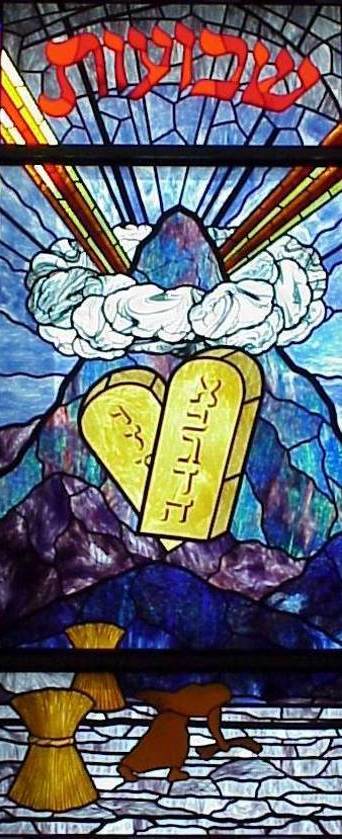
Now, I am fully aware that the origins of this holiday were largely connected to the harvest -- the Festival of Weeks (since Shavuot means weeks in Hebrew), which began with the harvesting of barley during Pesach and ended with the harvesting of wheat during Shavuot, is the conclusion of the festival of the grain harvest. Perhaps the more commonly and widely observed aspect of the holiday, however, is that Shavuot is the commemoration of the giving of the Torah at Sinai. Furthermore, it's become a big holiday for consuming oodles of delicious dairy delicacies, which is something I can really wrap my fingers around. Now, there are no Torah prescriptions for this holiday outside of abstention from work, special prayer, and holiday meals, but that hasn't stopped us from really taking on the many traditions of the day (or two in the Diaspora). There is a great mnuemonic device that is used to remember these customs: acharit (אחרית, "last")
  • אקדמות – Akdamot, the reading of a liturgical poem during Shavuot morning synagogue services
  • חלב – Chalav (milk), the consumption of dairy products like milk and cheese
  • רות – Ruth, the reading of the Book of Ruth at morning services
  • ירק – Yerek, the decoration of homes and synagogues with greenery
  • תורה – Torah, engaging in all-night Torah study.
Of course, perhaps the biggest treat for me during Shavot is the reading of Ruth, if for no other reason than that Ruth is the tour de force name issued when it comes to converts -- she's sort of the mother of converts everywhere. Her name is issued often, as even after her husband died and she was asked by her mother-in-law Naomi to turn back to her family, Ruth followed Naomi all the way back to the land, stating fervently, "Your people shall be my people, your G-d shall be my G-d." Those, folks, are the magic words! I could write a lot more about Ruth, Naomi, and their fabled relationship, but we'll save that for another time and place. 

As for where the dairy consumption comes from, there are a few different ideas behind the tradition. One of the  most interesting, I think, is that since we didn't have the laws of how to properly butcher animals, the Israelites opted instead to eat dairy until Moses returned from receiving the laws. Makes sense, no? Another idea is that the tradition comes from the fact that Israel is referred to many times over as the land flowing with "milk and honey." Even further, the gematria (numerical value) of milk -- chalav -- is 40, which commemorates the 40 days and nights that Moses spent atop Sinai. Fascinating!

Right now, the internet is flowing with lots of blog posts on Shavuot, and as the holiday approaches this evening, Jews everywhere prepare to shut down their computers and cell phones to take on the two day chag -- after all, Shavuot is two days, but since it falls during Shabbos, it's really two days Shavuot mixed in with some Shabbos. Talk about an exciting few days. 

Hopefully, I'll come out on the other side of the chag with some interesting tidbits and reflections on schlepping across the neighborhood, downing lots of dairy, and hearing the book of Ruth read as so many Jews all over the world also will. It's a powerful thing, I think, and I'm so excited that for the first time this year I'll be there, experiencing it. 

Until then? I'll continue to watch the Spelling Bee on ESPN, dream of cheesecake, and nosh kosher berry muffins. 

Chag sameach! May your chag be filled with study, prayer, dairy delicacies, friends, family, and peace.

Mar 30, 2009

Scribe at Work!

I'm amazed. This is more tantalizing than watching the new puppies bounce about in their little incubator-style habitat! It's not just because the calligraphy is so beautiful, or that this old guy is letting himself be filmed making the scroll (no pressure! no pressure!). It's neat because it brings the Torah to life, a little bit, letter by letter. Just go here to View the Scribe at work! Here, this is a better explanation, from Mendy Pellin, even!:


The coolest thing? You can purchase a letter in honor of an IDF soldier, or in your name, or your bubbe's name! It's that easy! Of course, I'm not sure how that works and what kind of acclaim (not that it's necessary) one would get for the mere $1 a letter. If they can sell a letter for every one in the Torah? That's a whopping $304,805. Mazel tov!

For more information on the awesome little project, check out AskMoses.com.

Dec 1, 2008

Check out my good friend Esther K on G-dcast!


More Torah cartoons at www.g-dcast.com

Nov 14, 2008

A Test of Faithfulness.

This week's parshah is the famed akeidah story -- Vayeira -- the binding of Isaac by Abraham. I'm not going to go into a gigantic d'var Torah, but I do want to say a few words.

The interesting thing about this situation is that people debate who failed G-d's test and who had true faithfulness to G-d: was it Isaac or Abraham? Did Isaac have faith that G-d would not allow his father to go through with the sacrifice? Or did Abraham have faith that G-d would not let him go through the sacrifice? At the same time, consider this: Did Abraham FAIL the test?

So here's my take: The Torah is written, as my professor likes to say, in the language of the people of the times. Ethical Monotheism -- what we know today as Judaism -- grew out of a slip away from pagan and cultic religions of the times. Human sacrifice was commonplace, and G-d was well aware of this. Thus, when this brilliant monotheism arose, G-d knew that the people Israel would need to remove themselves from the pagan rituals of the day. Thus, in this case, G-d tells Abraham to sacrifice his son, Isaac, and Abraham -- not having fully grasped the concept of what G-d was shooting for when it came to the monotheism and not needing pagan rituals -- went along wholeheartedly with the plan. Isaac, on the other hand, knew what was going on. He had faith that G-d would keep Abraham from going through with it. At the same time, both G-d and Isaac hoped that Abraham would catch the drift that with G-d's way, human sacrifice wasn't an imperative. Unfortunately, Abraham failed the test and G-d had to stop him from going through with it. Talk about an interesting situation.

Of course, this is just my take. What the implications of Abraham's failure with G-d are, I cannot say right now. If anything, it was just the first in many missteps of the people while trying to get the hang of the non-pagan, ethical monotheism slant, which to be honest they didn't seem to pick up on until well into Isaiah (even Jethro tells Moses that his G-d is the greatest of all G-ds -- the Tanakh is peppered with monolatry!).

At any rate, Shabbat Shalom to one and all! May it be restful, thoughtful, and be shared with friends and family over good food and good stories.

Nov 4, 2008

Go Forth!

Amid the chaos of the day, there must be a little peace. Thank G-d, therefore, that this week's parshah is my defining parshah -- Lech Lecha.

The great thing about this parshah -- the namesake for which decorates my signature on my emails -- is it's opening message: "Go forth." I blogged about this portion last year on JewsbyChoice.org , of which I was once a contributor. The Midrash tells us that this line means "Go forth to find your authentic self, to learn who you are meant to be." That is, indeed, what Abraham and Sarah did, and it's most definitely what the convert does. Thus, for me, it's such a powerful, powerful portion.

Another great thing about this week's portion? My friends, Stereo Sinai (that's Mirriam and Jay) back in Chicago were awesome and did up this week's G-dCast.com video! It's beautiful, and poetic, with the singing and the music illustrating the portion. Watch it, take it in, and then go visit Stereo Sinai and pick up some of their tunes -- they are a truly talented duo, in more ways than one!


Parshat Lech Lecha from g-dcast on Vimeo.

Oct 23, 2008

"Light is Hidden Away for the Righteous Ones"

This week, we begin the cycle of Torah reading all over again with the first parshah: Bereshit. So it says "In the beginning ..." I've blogged in the past I do believe about this portion, and it's one of my favorites. It's not just because there's this freshness about starting the year again, reliving the steps of the words of Torah year after year, but also because of how it begins. The entire Torah starts off with the letter bet, which looks like this:
What's so special about this? The rabbis and sages taught that this beginning letter serves a special purpose, considering one might suspect that TaNaKh would begin with an aleph to follow some type of higher principle. Because Hebrew is written right to left, we are taught (via Midrash Bereshit Rabbah) that just as the bet is closed on the top and at the sides, you are not to investigate what is below, what is above, or what comes before -- rather, you must investigate and seek out what is in front.

Some other suggested takes on the use of bet as the first letter of Torah? One sage thought it was because the letter bet connotes power because of the force of the air (ruach) being spoken forth, and another thought that by starting with a bet rather than an aleph, the almighty was in effect revealing that man did not know the first principles about creation (I kind of like this one). Also, for more on this topic, check out Ilana-Davita's blog post on the same topic!

I won't get into a long discussion about the parshah itself, because I'm offering up this stellar new video series called G-dcast , which throws up a new animated piece of the series every Monday. This week's piece features Rabbi Lawrence Kushner and discusses the purpose of "light" in this week's portion and why we have two creations of light in the first creation story of Genesis 1. It's really a fascinating and cool little animated video. Give it a go, will you?


G-dcast: Parshat Bereshit from g-dcast on Vimeo.

Sep 14, 2008

A Little Ditty.

I went to the library yesterday to get a bit of studying done and what did I end up doing? Checking out FOUR books. Only one of which was relevant to anything I am academically working on at the moment -- The Song of Songs by Ariel Bloch and Chana Bloch, which is an interesting presentation of commentary on the text as well as other notes and interesting tidbits about the poem. The other three? Martin Buber's "Way of Man," Jordan Jay Hillman's "The Torah and Its G-d," and "The limits of Orthodox Theology" by Marc Shapiro. The latter is a reappraisal of Maimonides' Thirteen Principles, and it looked like an intriguing read. The Buber book is incredibly short and features the teachings of Hasidism, while the Hillman book appears to be a humanist inquiry into the five books of Moses. If anyone has read any of these and has some words/musings, please comment!

Will I read them all? Who knows. I'm still trying to wrestle through Sarna's "Exodus," while needing to develope a working bibliography for two different papers of which I have yet to pick topics (name changing -- Sarah/Abraham/Jacob; maybe the idea of repentance in scripture; maybe the idea of whether Rachel was stealing the idols to worship them? who knows). Stay tuned, of course. Oh man, I still haven't blogged about "The Search Committee" and it's a week later. Where did the week go?!

At any rate, until I come up with a clear plan of attack for my many books and develop a vlog about what to do when you're a million miles away from a rabbi or perhaps only have a rabbi in a movement with which you don't necessarily want to be affiliated ... be sure to check out this week's Haveil Havalim over on Shiloh Musings.

 
Design by Free WordPress Themes | Bloggerized by Lasantha - Premium Blogger Themes Powered by Blogger | DSW printable coupons